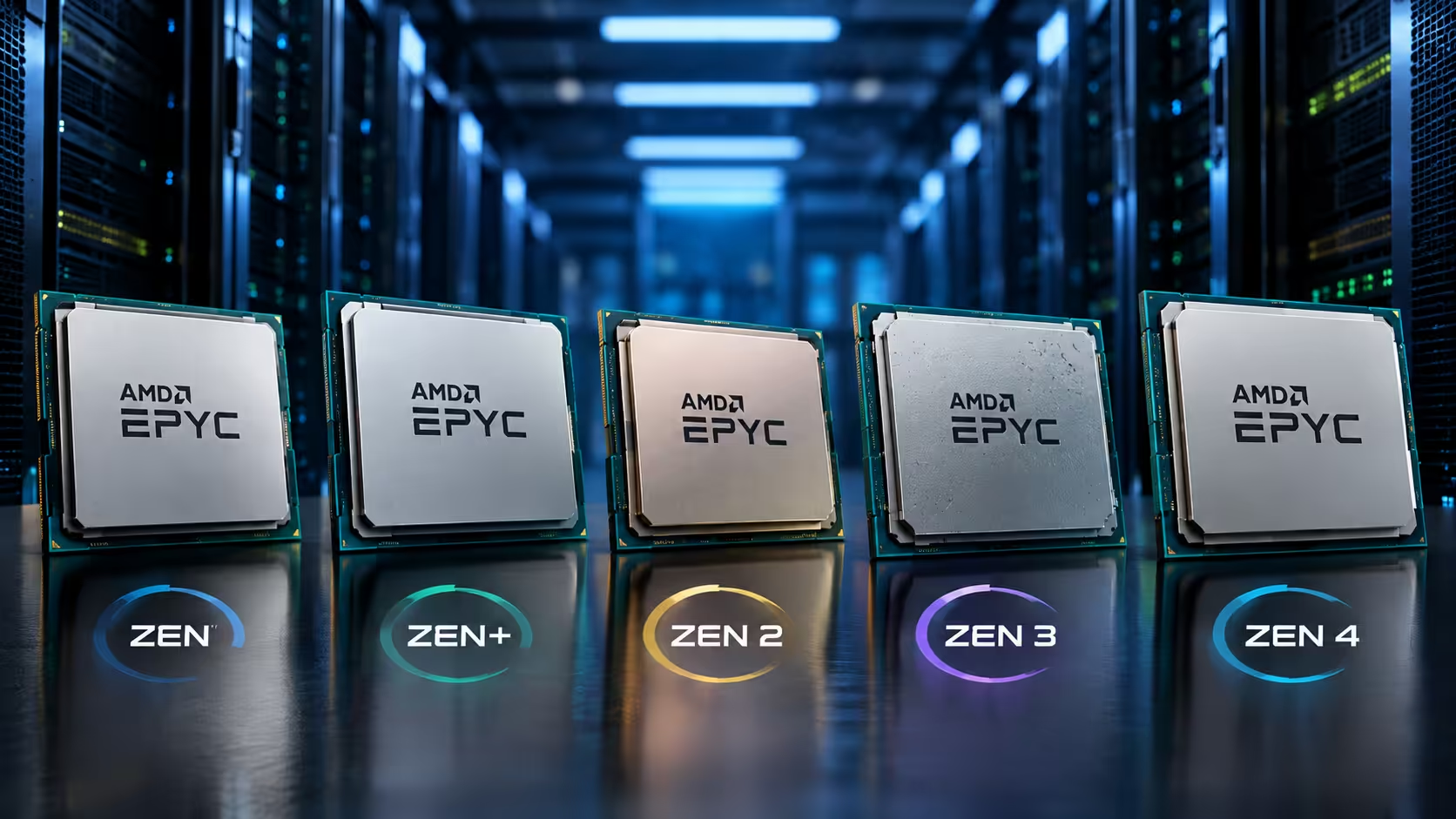
Since its debut in 2017, AMD's EPYC processor line has fundamentally reshaped the server CPU market. From the modest 32-core Naples chips to the current 192-core Turin monsters, AMD has systematically dismantled Intel's decades-long dominance in enterprise computing. Today, AMD holds a substantial share of the x86 server CPU market, driven by a relentless cadence of architectural innovation. This comprehensive guide covers every server generation of EPYC, the chiplet design philosophy that made them possible, and why the 5th Gen Turin processors have become the standard for AI-era data centers.

In this article, we examine all seven server generations of EPYC, from Naples to Turin and the upcoming Venice. We analyze the chiplet design, memory and I/O evolution, security features, and benchmark performance.
The Complete EPYC Generational Timeline (2017–2026)
AMD's EPYC journey spans nearly a decade. Each generation brought a process node shift, architectural improvement, and a significant jump in core count or efficiency [citation:1][citation:8].
| Generation | Codename | Year | Architecture | Process | Max Cores | Socket |
|---|---|---|---|---|---|---|
| 1st Gen | Naples | 2017 | Zen | 14 nm | 32 | SP3 |
| 2nd Gen | Rome | 2019 | Zen 2 | 7 nm | 64 | SP3 |
| 3rd Gen | Milan / Milan-X | 2021–2022 | Zen 3 | 7 nm | 64 | SP3 |
| 4th Gen | Genoa / Genoa-X / Bergamo / Siena | 2022–2023 | Zen 4 / Zen 4c | 5 nm | 128 | SP5 / SP6 |
| 5th Gen | Turin | 2024 | Zen 5 / Zen 5c | 4 nm / 3 nm | 192 | SP5 |
| 6th Gen | Venice | 2026 | Zen 6 / Zen 6c | 2 nm | 256 | SP7 / SP8 |
The evolution from 32 cores on 14nm to 192 cores on 4nm represents a 6x increase in density across five generations, with each step enabled by process node improvements and AMD's chiplet architecture [citation:8][citation:21].
The Naples Era (2017): AMD's Bold Return to Servers
The first-generation EPYC 7001 series, codenamed Naples, launched in June 2017 and marked AMD's re-entry into the server market after years of Opteron decline. Built on the Zen architecture at 14nm, Naples offered up to 32 cores and 64 threads per socket, with 128 PCIe 3.0 lanes and 8 channels of DDR4-2666 memory [citation:28][citation:34].
The chiplet approach was present from day one: Naples was composed of four 14nm compute dies, each with up to 8 cores, connected to a central I/O die. This multi-chip module design allowed AMD to achieve higher yields than traditional monolithic dies while maintaining a competitive price point.

Security was a differentiator from the start. Naples was the first server CPU with an integrated dedicated security processor, providing the foundation for Secure Memory Encryption (SME), Secure Boot, and Secure Encrypted Virtualization (SEV) [citation:22].
Rome (2019): The 7nm Revolution
The second-generation EPYC 7002 series, codenamed Rome, launched in August 2019 and was the first 7nm x86 server processor in the industry. Rome doubled the core count to 64 cores and 128 threads per socket while moving to PCIe 4.0 [citation:1][citation:28].
Rome's chiplet design was refined: eight 7nm compute dies surrounding a 14nm I/O die. This hybrid approach allowed AMD to use advanced process technology for the compute cores while keeping the I/O die on a mature, cost-effective node.

The flagship EPYC 7H12 delivered 64 cores at 2.6 GHz base and 3.3 GHz boost, with 256 MB of L3 cache and a 280W TDP. It achieved 2P HPL performance of 4.1 TFLOPS and SPECrate 2017 Integer Base of 670.
Milan (2021) and Milan-X (2022): Zen 3 and 3D V-Cache
The third-generation EPYC 7003 series, codenamed Milan, launched in March 2021 and brought the Zen 3 architecture to servers. While core count remained at 64, Milan delivered a 19% IPC uplift and 40% better performance per watt compared to Rome [citation:9][citation:15].

The flagship EPYC 7763 packed 64 cores and 128 threads at 2.45–3.50 GHz with 256 MB L3 cache and a 280W TDP. Milan's SEV-SNP (Secure Nested Paging) added system integrity protection, preventing malicious hypervisor attacks through replay or remapping.
In March 2022, AMD launched Milan-X, stacking an additional 512 MB of L3 cache on each compute die using through-silicon vias, bringing total cache per CPU to 768 MB. The flagship EPYC 7773X delivered this massive cache pool for memory-bandwidth-bound workloads like computational fluid dynamics and EDA [citation:2][citation:15].
Genoa, Bergamo, Genoa-X, and Siena (2022–2023): The 4th Gen Family
The fourth-generation EPYC 9004 series, codenamed Genoa, launched in November 2022 and represented the biggest platform shift since Rome. Genoa moved to the new SP5 socket, introduced 12 channels of DDR5-4800 memory, and brought PCIe 5.0 and CXL 1.1 support [citation:20][citation:23].

Core counts jumped to 96 cores and 192 threads per socket. The chiplet design evolved again: up to 12 compute dies built on 5nm, connected to a 6nm I/O die [citation:27].
AMD expanded the 4th Gen lineup with three specialized families:
- Bergamo (EPYC 97x4): Used the Zen 4c architecture to deliver up to 128 cores per socket, optimized for cloud-native workloads where density and power efficiency matter more than peak single-core frequency [citation:10].
- Genoa-X (EPYC 9004 with 3D V-Cache): Brought the cache stacking technology to Genoa, achieving up to 1,152 MB of L3 cache per CPU. The flagship EPYC 9684X with 96 cores delivered 1.1 GB L3 cache [citation:10][citation:16].
- Siena (EPYC 8004): Targeted edge and entry-level servers with the new SP6 socket, up to 64 Zen 4c cores, 6 channels of DDR5-4800, and a 225W cTDP. It removed dual-socket support to optimize cost and power [citation:30][citation:37].
Turin (2024): The 192-Core Zenith
The fifth-generation EPYC 9005 series, codenamed Turin, launched in October 2024 and represents the current pinnacle of x86 server processing. Turin uses the same SP5 socket as Genoa, enabling drop-in upgrades for existing 4th Gen platforms, but dramatically increases core counts and frequencies [citation:1][citation:11].

Turin comes in two flavors: standard Zen 5 dies with 8 cores and 32 MB L3 cache each, and dense Zen 5c dies with 16 cores and 32 MB L3 cache each. The flagship EPYC 9965 combines 12 Zen 5c dies for a total of 192 cores and 384 threads at 2.25 GHz base [citation:11][citation:33].
The memory subsystem supports DDR5-6400, with 12 channels delivering up to 614 GB/s of bandwidth per socket. PCIe 5.0 lane counts remain at 128 single-socket / 160 dual-socket, with up to 64 lanes configurable as CXL 2.0 [citation:4][citation:17].
AVX-512 implementation is now full-width: Zen 5 processes 512-bit instructions natively in a single cycle, versus the split 256-bit execution in Zen 4. AMD claims a 2-socket EPYC 9965 server outperforms a 2-socket 96-core Genoa 9654 system by approximately 2.75x on HPL [citation:11].
Performance Benchmarks: Turin in the Real World
Independent testing confirms Turin's dominance. In SPEC CPU 2026 Integer Rate, a Dell PowerEdge M7725 with dual EPYC 9755 (128 cores each) achieved a SPECrate 2026_int_base score of 1,070, with floating-point reaching 991 [citation:17].

For high-frequency workloads, the EPYC 9575F with 64 cores at up to 5.0 GHz boost reached SPECspeed 2017_int_base of 20.3. These results position Turin at the top of the x86 server performance hierarchy [citation:33].
The Road Ahead: Venice (2026) and Beyond
AMD's published roadmap extends to 2030. The sixth-generation EPYC 9006, codenamed Venice, has already been announced with the Zen 6 and Zen 6c architectures on a 2nm process. It will introduce the SP7 and SP8 platforms, supporting up to 256 cores and 512 threads, PCIe Gen 6, and DDR5/MRDIMM memory [citation:5][citation:18].
Venice is expected to arrive in late 2026 for SP7 systems and early 2027 for SP8. Industry reports suggest AMD has already sold out its 2027 production capacity [citation:7].
Further ahead, AMD has confirmed the Venice-X with 3D V-Cache (up to 96 cores, 1,152 MB L3) and the Verano processor for agentic AI, featuring SOCAMM2 memory support. Both are planned for 2027 [citation:6][citation:13].
Conclusion: The New Standard for Server Computing
AMD's EPYC line has transformed the server market from a single-vendor monopoly into a competitive landscape driven by architectural innovation. From the 32-core Naples to the 192-core Turin and the upcoming 256-core Venice, each generation has pushed the boundaries of density, efficiency, and performance [citation:1][citation:8].
For organizations running large-scale databases, AI inference, HPC simulations, or virtualized infrastructure, the EPYC portfolio offers a compelling combination of performance, efficiency, and platform stability. The ability to replace 100 older servers with 13 new ones while cutting power consumption by 68% is not just a benchmark victory — it's a fundamental shift in data center economics.
With Intel's competitive response still maturing, AMD has established a clear leadership position in x86 server CPUs for 2026 and beyond.
 Dana Crandall
Technical Writer & Research Analyst
eBits Tech Platform
@ eBits.icu