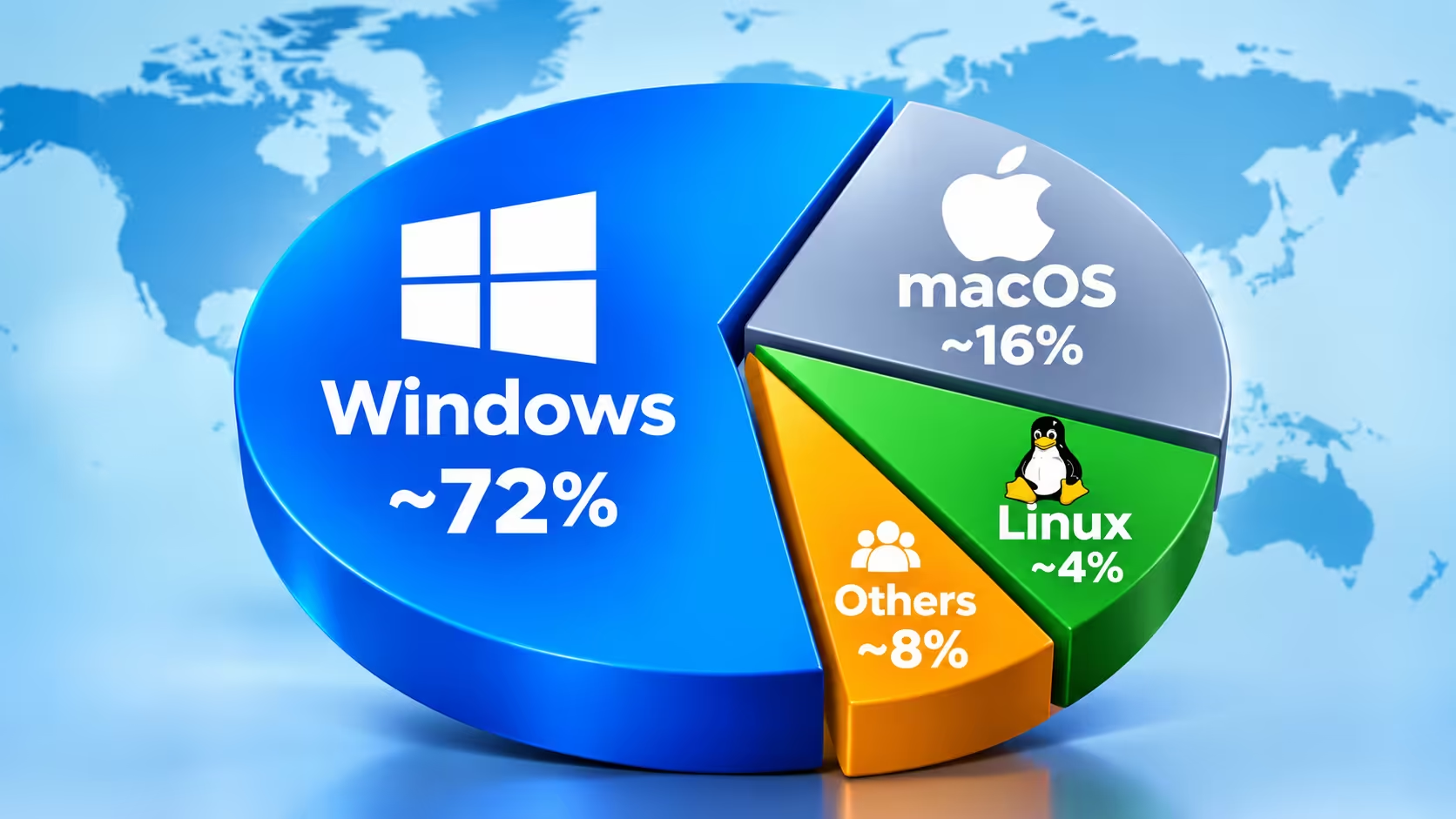
The desktop operating system market in September 2026 presents a landscape defined by Windows' continued dominance, Apple's resilient ecosystem, and Linux's complex and often misunderstood position. This comprehensive analysis examines the latest Statcounter data, the methodology behind the numbers, and what the trends reveal about the future of desktop computing.
Source: StatCounter Global Stats - OS Market Share
This article provides a complete breakdown of the global desktop operating system market share as of September 2026. It covers the dominance of Windows and its version distribution, the combined strength of Apple's macOS and OS X platforms, the reality behind Linux's fluctuating numbers and the bot traffic controversy, ChromeOS's position in the education and budget segments, and the methodology that shapes how these statistics are collected and interpreted. The goal is to offer a definitive reference for developers, IT professionals, and technology analysts seeking to understand the desktop OS landscape.
Windows: The Undisputed Leader in September 2026
Microsoft Windows continues to dominate the global desktop operating system market with a share of 76.36% as of September 2026. This represents a significant recovery from the previous month, when Windows briefly dipped to 63.03% in August, a figure that was later attributed to a statistical anomaly in the data collection process.
The recovery in September is largely due to a substantial gain in Windows 11 adoption. According to Statcounter data, Windows 11 reached a global market share of 71.5% among all Windows versions, up from 68.6% in August. This represents an increase of 2.9 percentage points in a single month, the largest jump recorded since March 2026. Meanwhile, Windows 10 fell to 27.77%, a decline of 2.38 percentage points and its lowest level since the operating system was released in 2015.
The shift is even more pronounced in specific markets. In Germany, Windows 11 reached a record 79.89% share, while Windows 10 dropped to 19.53%, the lowest level since November 2015. This suggests that German users, historically more conservative in their operating system choices, have finally begun to migrate away from Windows 10 in significant numbers. The trend appears uniform across all continents, with Windows 11 gaining in the Americas, Europe, Asia, and the rest of the world simultaneously, making the September data more robust than previous months where single-market anomalies distorted the global picture.
Older Windows versions have become statistically negligible. Windows 7 holds just 0.55% of the global market, Windows 8.1 sits at 0.09%, Windows XP at 0.05%, and Windows 8 at 0.02%. These legacy systems, once dominant, now represent a combined total of less than 1% of desktop usage worldwide.
Apple's Dual-Platform Strategy: macOS and OS X
Apple's position in the desktop operating system market is more complex than a single number suggests. Statcounter reports Apple's desktop platforms on two separate lines: OS X and macOS. In September 2026, OS X recorded 10.65% market share, while macOS recorded 6.09%. Combined, Apple's total desktop presence amounts to 16.74%, placing the company comfortably in second position globally.
This dual-line reporting reflects an artifact of how Statcounter categorizes Apple's operating systems. "OS X" is the legacy designation used for older versions of the Mac operating system, while "macOS" represents the modern naming convention introduced by Apple in 2016. The distinction is primarily historical rather than technical, and for market analysis purposes, the combined figure is the most meaningful metric.
Apple's combined share fluctuated significantly throughout 2026. In July, the total was 19.90%, rising to 26.65% in August before settling at 16.74% in September. This volatility is largely attributable to the same statistical adjustments that affected Windows and Linux during the same period. The August figure, in particular, appears to have been inflated by the temporary classification of traffic that was subsequently reallocated in September.
In Germany, Apple's presence is notably stronger than the global average. OS X recorded 12.8% share in Germany, while macOS added 3.43%, for a combined total of 16.23%. This places Germany among the markets where Apple has a more significant foothold, though Windows still commands over 76% of the German desktop market.
Linux: The Bot Traffic Controversy and the Reality Behind the Numbers
Linux's desktop market share in 2026 presents one of the most confusing and controversial data stories in the technology industry. In August 2026, Statcounter reported Linux reaching 8.88% of global desktop usage, with some reports claiming figures as high as 18% in the United States. By September, those numbers had collapsed to 4.54% globally, a drop of more than four percentage points in a single month.
The explanation for this dramatic swing lies in automated traffic. According to analysis by WebProNews and other technology publications, the August spike was largely driven by AI bots and automated agents running on Linux infrastructure. These bots flooded web analytics platforms with traffic that was mistakenly attributed to human Linux desktop users. When Cloudflare Radar data was filtered for human-only traffic, Linux's share stabilized at approximately 4.7% over recent months, a figure much closer to its historical average.
This bot traffic phenomenon has significant implications for how market share data should be interpreted. Statcounter's methodology relies on tracking code embedded in websites, which counts all traffic regardless of whether it originates from human users or automated systems. As AI agents and automated browsing tools become more prevalent, distinguishing between human and bot traffic becomes increasingly critical for accurate market analysis.
The September adjustment, which Statcounter described as a "drastic reajuste," brought Linux back to 4.54% globally. This figure represents a more realistic baseline for Linux's actual desktop presence, though even this number may include some automated traffic. The open-source operating system has nonetheless grown significantly from its historical position of around 2-3% just a few years ago, driven by factors including improved gaming support through Valve's Proton compatibility layer, wider hardware availability from manufacturers like System76 and Framework, and growing enterprise interest in Linux-based systems.
ChromeOS: The Education and Budget Segment
Google's ChromeOS holds a modest but stable position in the desktop operating system market. In September 2026, ChromeOS recorded 2.31% of global desktop pageviews, up from 1.56% in August and 1.47% in July. This represents a gradual but consistent growth trend throughout the year.
The broader picture for ChromeOS, however, is more nuanced. According to Omdia forecasts from March 2026, ChromeOS devices are expected to account for 5.7% of PC shipments in 2026, down from 6.9% in 2025. This represents a decline of 27.6% in unit shipments, a significant contraction attributed to the platform's heavy weighting in the education sector, tighter component allocation, lower margins, and the discontinuation of certain memory and storage components.
ChromeOS's market share varies dramatically by region. In Sweden, ChromeOS reached 15.34% of desktop pageviews, making it a significant player in that market. At the opposite extreme, Japan recorded just 0.42% ChromeOS share, reflecting the platform's limited penetration in that country. This regional variation reflects the different priorities and procurement patterns of educational institutions, enterprises, and consumers across different markets.
FreeBSD and Niche Operating Systems
Beyond the major platforms, FreeBSD maintains a small but dedicated presence in the desktop and server operating system market. According to 6Sense data, FreeBSD holds approximately 0.35% market share in the combined server and desktop OS category, with an estimated 6,537 customers worldwide. The operating system has a particularly strong presence in the United States (52.99% of its customers), Brazil (12.09%), and the United Kingdom (6.00%).
FreeBSD's customers include notable organizations such as Nintendo, Capgemini, Yale University, and the National University of Singapore. While its overall market share is negligible compared to Windows, macOS, and Linux, FreeBSD remains an important platform for specialized applications where its performance characteristics and licensing model are advantageous.
Understanding the Methodology: What Statcounter Data Really Measures
Any analysis of operating system market share must begin with a clear understanding of what the data actually measures. Statcounter, the primary source for these statistics, does not count installed operating systems or devices. Instead, it tracks website pageviews across a network of over 1.5 million websites that use its analytics code. The data reflects the operating system reported by the browser when accessing those websites, which is then aggregated and reported as market share.
This methodology has several important implications. First, the data reflects usage patterns rather than installed base. An operating system that is installed on many devices but used infrequently will appear to have a lower market share than its installation numbers would suggest. Second, the data is skewed by the types of websites in Statcounter's network. If certain operating systems are more prevalent among users of specific types of websites, this will be reflected in the aggregate numbers. Third, and most critically in 2026, the data is increasingly contaminated by automated traffic from bots and AI agents that may report operating systems that do not correspond to actual human users.
The "Unknown" category in Statcounter's data has grown significantly, from 11.3% in September 2025 to 21.5% in June 2026. This growth mirrors the decline in Windows share during the same period, suggesting that privacy tools masking operating system information may account for a substantial portion of what appears to be a Windows decline. Analysts caution that the unknown category is likely masking real usage patterns rather than representing a genuine migration away from any particular platform.
Conclusion: A Market in Transition
The desktop operating system market in September 2026 is characterized by Windows' continued dominance, Apple's stable second position, and Linux's complex and often misunderstood trajectory. Windows holds 76.36% of the global market, with Windows 11 now accounting for 71.5% of all Windows installations. Apple's combined macOS and OS X share of 16.74% places it firmly in second position, while Linux's 4.54% represents a correction from the inflated figures of August.
The key takeaway from the 2026 data is that the desktop operating system market is more stable than the monthly fluctuations suggest. Windows remains the default choice for the vast majority of desktop users worldwide. Apple's ecosystem continues to command a loyal and substantial user base. Linux, while growing from its historical lows, remains a niche platform for desktop use, with its apparent surges often attributable to automated traffic rather than genuine user migration.
For developers and IT professionals, the practical implications are clear: Windows remains the primary target for desktop software development, followed by macOS. Linux support is valuable for specific markets and use cases but does not represent a mass-market opportunity for desktop applications. ChromeOS is relevant primarily in education and budget segments. And as always, the data should be interpreted with an understanding of its methodology and limitations, particularly in an era where automated traffic increasingly distorts the picture of human computing behavior.
 Lorraine Hayes
Cloud Architect / Content Designer
eBits Tech Platform
@ eBits.icu