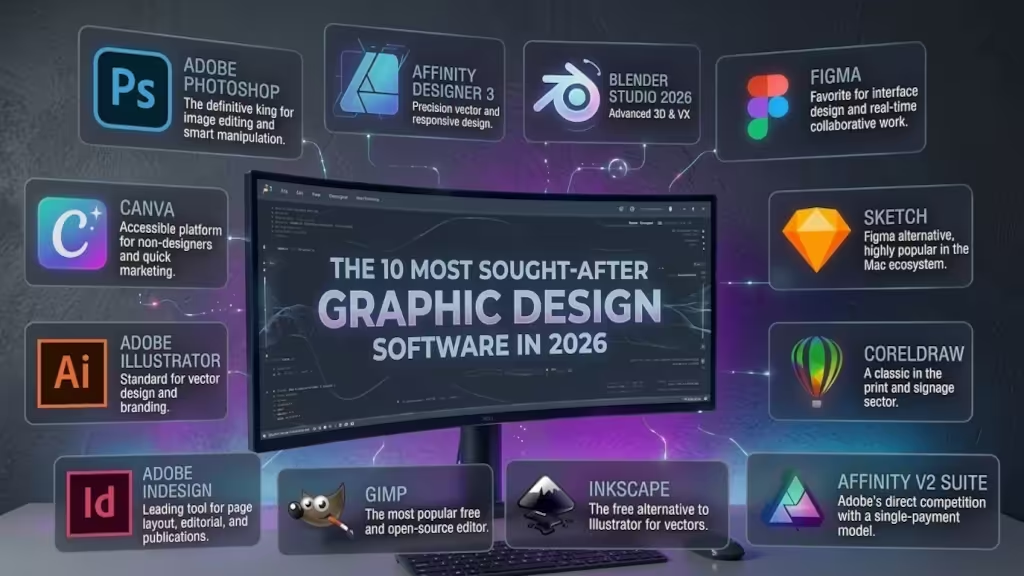
From the Adobe ecosystem to AI-powered design platforms, the graphic design software landscape has expanded beyond the traditional heavyweights. This article identifies the top 10 most searched-for tools in 2026, analyzing their market share, user appeal, and specific use cases to help you choose the right platform for your workflow. The graphic design software industry has undergone a fundamental shift in 2026.
While established tools remain strong, a new generation of platforms, many leveraging AI, has taken a significant share of the market. This analysis is based on search trend data, market share metrics, and user reviews from leading business software platforms to determine the top contenders for the year. The following list represents the most sought-after tools globally, driven by a combination of professional necessity and the democratization of design.
1. Adobe Photoshop
Adobe Photoshop continues to dominate the graphic design landscape as the most recognized and widely used tool globally. An analysis of review data shows it consistently ranks first among business users, with thousands of reviews highlighting its indispensable role in professional editing workflows [citation:8]. Its versatility remains unmatched, making it a standard for businesses across every sector [citation:1]. From photo retouching to creating complex visual effects, Photoshop's extensive toolkit is often the only option for high-end professional work [citation:6].
One reviewer described it as "essential," noting its critical role in producing high-quality visuals [citation:6]. Its widespread adoption is also evident in market share data, where it held approximately 1.71% of a highly fragmented market, translating to over 165,000 companies using it [citation:1].
2. Canva
Canva is the definitive success story of this decade. From a design tool for beginners, it has evolved into a massive platform with over 250 million monthly active users [citation:3]. Its rise is reflected in search trends and market data; it is the primary driver of the shift away from traditional desktop publishing tools [citation:3].
While it may not offer the deep editing capabilities of Photoshop or Illustrator, Canva's ease of use, extensive template library, and speed make it the go-to choice for marketing teams, small business owners, and social media managers [citation:2]. It is highly rated for workflow efficiency, with one user reporting their team reduced asset creation time by 80% [citation:11].
3. Adobe Illustrator
For vector graphics, Adobe Illustrator remains the industry standard. It is widely used for creating logos, illustrations, and any content that needs to be scaled without losing quality [citation:6]. With a market share of 2.27% and approximately 219,000 companies using it, it is one of the most popular design tools available [citation:1].
It excels in precision and control, allowing designers to craft intricate details that are essential for professional branding and publication work [citation:6]. It is deeply integrated into the professional design ecosystem, making it a cornerstone tool for most agencies and design teams [citation:6].
4. Adobe InDesign
Adobe InDesign is the leading software for page layout, publication design, and print media. It is heavily used for creating magazines, brochures, and books, with advanced typography and grid systems that make it irreplaceable for these specific tasks [citation:6].
Its popularity in this niche is significant, with over 48,000 companies adopting it as their primary layout tool [citation:1]. For anyone working in print or multi-page publications, InDesign is the professional's choice [citation:6].
5. Figma
Figma has become essential for UI/UX and product design teams. Its main advantage is its real-time collaboration features, which enable multiple team members to work on the same file simultaneously [citation:6]. This has revolutionized the design feedback and revision process, reducing revision cycles by as much as 60% [citation:6].
While it is used heavily in the design world, its market share in general "graphic design" software was approximately 0.53% as of the latest data, indicating its specialized focus on product teams rather than general print or branding workflows [citation:1].
6. Sketch
Sketch is another powerful tool for the UI/UX industry, particularly for those in a Mac-only ecosystem. It is a native macOS application optimized for screen design, featuring a focus on vector workflows and extensive libraries [citation:6][citation:12].
It offers a $120 one-time license option for offline use, which makes it an attractive purchase for solo designers, though this version lacks collaboration features available in the subscription model [citation:12]. It is a top contender for product teams committed to macOS [citation:12].
7. CorelDRAW
CorelDRAW has remained a relevant player for decades due to its robust capabilities in the print and sign-making industry [citation:7]. It combines vector illustration, page layout, and photo editing in a single suite with deep support for color separations and large-format output [citation:7].
In 2026, it has integrated AI-powered features like AI Generate and AI-powered background removal, keeping it competitive [citation:7]. While it holds a smaller market share of 0.12%, it is a crucial tool for businesses in physical production [citation:1].
8. Affinity V2 Suite
The Affinity suite, including Designer, Photo, and Publisher, is known for providing professional-grade design tools for a one-time purchase price [citation:2]. It offers a compelling alternative to Adobe's subscription model, especially for budget-conscious professionals or small businesses [citation:2].
Since its acquisition by Canva, its momentum has grown, aiming to provide a powerful and accessible toolset for a wider audience [citation:3]. It is particularly noted for its fast performance, even on large projects [citation:2].
9. GIMP
GIMP (GNU Image Manipulation Program) is the leading free and open-source alternative to Photoshop [citation:7]. It is highly popular among freelancers, startups, and users who need a powerful raster editing tool without the cost [citation:7].
It supports layers, masks, and plugins for complex editing workflows and can process large batches of images [citation:7]. While it lacks the native CMYK support needed for professional print, it is a go-to tool for web and screen-based work [citation:12].
10. Inkscape
Inkscape is the premier open-source vector graphics editor, offering a free alternative to Adobe Illustrator [citation:7]. It is a tool with precise path editing, native SVG support, and a strong community of developers and users [citation:7].
It is ideal for bootstrapped businesses and users looking to create logos, icons, and web graphics without a software budget [citation:7]. It operates on a steep learning curve but offers professional-level functionality at zero cost [citation:7].
Conclusion
The most searched-for graphic design software in 2026 represents a diversity of needs. While the Adobe Creative Cloud remains a powerhouse for professionals, Canva and open-source alternatives are seeing a massive increase in adoption, driven by ease of use and cost considerations. The tools that are winning in 2026 are those that integrate AI to speed up workflows or provide powerful, accessible solutions for a growing and democratized creator economy.
 Grace Sterling
Embedded Systems Engineer & Technical Writer
eBits Tech Platform
@ eBits.icu