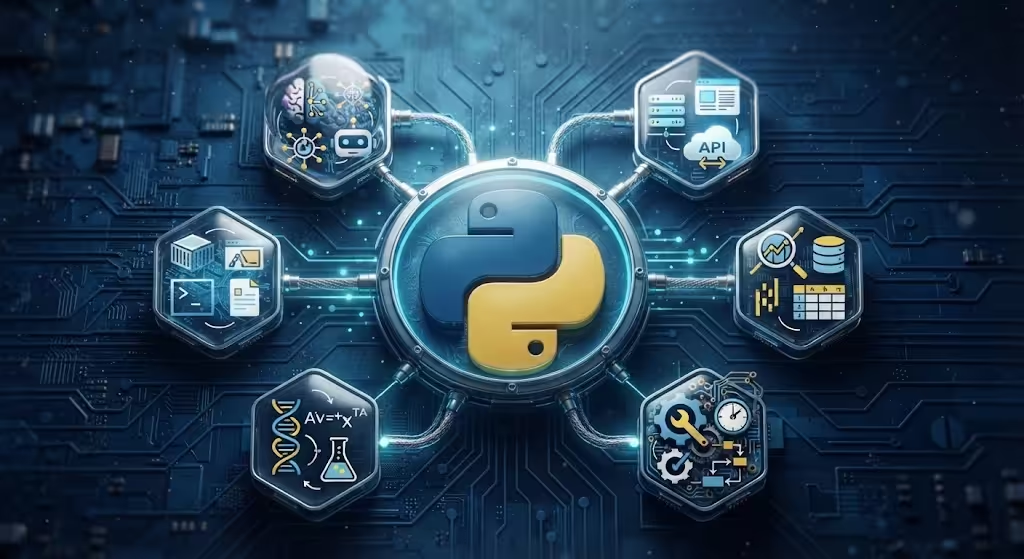
Python has evolved from a general-purpose scripting language into the foundational infrastructure of modern technology. In 2026, it commands over 21% of the TIOBE Index and powers everything from AI data centers to vineyard sensors. This comprehensive guide examines the twelve most impactful applications of Python across every sector, backed by academic research, industry data, and real-world deployments.
This extensive reference guide provides a complete analysis of Python's most significant applications in 2026. It covers artificial intelligence and machine learning, data science and analytics, web development with Django and FastAPI, automation and DevOps, scientific computing, embedded systems with MicroPython, data engineering, finance, healthcare, education, cybersecurity, and geospatial analysis. Each section includes current research, real-world examples, and the libraries that define the ecosystem. The goal is to offer a definitive resource for developers, researchers, and technology leaders seeking to understand Python's role in the modern world.
1. Artificial Intelligence and Machine Learning: The Dominant Application
Artificial intelligence and machine learning remain Python's most significant application domain in 2026. Every major AI framework is either written in Python or exposes a Python-first API, making the language unavoidable for anyone working in the field. According to Upwork's 2026 analysis, Python's dominance in AI is reinforced by the fact that the most important libraries—PyTorch, TensorFlow, and Hugging Face Transformers—are all Python-native.
The job market data confirms this dominance. The U.S. Bureau of Labor Statistics projects that data scientist roles will grow by 34% between 2024 and 2034, while software developer jobs will grow by 17.9%, both far above the average for all occupations. Python skills command a premium in these roles because the language sits at the center of machine learning, generative AI, and data science.
The generative AI boom has only solidified Python's position. The Hugging Face Transformers library, which provides access to thousands of pre-trained models, has become the standard for working with large language models. Frameworks like LangChain and LlamaIndex, which simplify the process of building applications with LLMs, are also Python-native. The most popular way to access powerful models like GPT-4 is through the OpenAI API, which has a Python-first SDK.
In practical deployments, Python's role in AI extends far beyond research. A 2026 IEEE paper describes a smart city management framework that integrates IoT streams, Big Data, AI, and Blockchain into a single engine. The framework uses a bidirectional LSTM forecaster achieving 89.35% accuracy and an XGBoost anomaly detector with an F1-score of 1.000, reducing simulated infrastructure downtime by a quarter through predictive maintenance. The entire system runs on a laptop without external services.
Another IEEE paper presents LARA, a multilingual voice-activated AI assistant for visually impaired users, developed using Python and combining speech recognition, natural language processing, and machine learning. The system enables hands-free interaction and incorporates emergency assistance features. These examples demonstrate that Python is not just a research tool; it is the language of deployed AI systems.
2. Data Science and Analytics: The Universal Language of Insight
Data science remains one of Python's most visible and widely adopted applications. The ecosystem of libraries for data manipulation, analysis, and visualization is unmatched by any other language. Cambridge University Press published a new edition of "A Hands-On Introduction to Data Science with Python" in January 2026, reflecting the continued demand for Python skills in academic and professional settings.
The core data science libraries continue to evolve. Pandas and Polars provide flexible data structures for cleaning and manipulating large datasets. NumPy remains the foundational library for numerical computation. For interactive analysis, Jupyter Notebooks have become the de facto environment, allowing data scientists to combine code, text, and visualizations in a single document.
Taylor & Francis published "Advanced Data Science and Analytics with Python" in 2026, with a second edition that significantly expands coverage of transformer architectures, generative AI, and agentic systems. The book covers self-attention, BERT, GPT, large language model evaluation, and API-based interaction, reflecting the rapid transformation of AI practice.
The practical applications of Python in data science extend across every industry. In healthcare, the University of Oxford published research on DiNetxify, an open-source Python package for three-dimensional disease network analysis based on electronic health record data. The package completed analyses involving cohorts exceeding half a million individuals within 17 hours using moderate computational resources. This demonstrates Python's capability to handle large-scale data analysis in sensitive domains.
3. Web Development and APIs: Django, Flask, and FastAPI
Python's role in web development has matured significantly, with three frameworks dominating the ecosystem: Django, Flask, and FastAPI. An IEEE comparative evaluation published in June 2026 provides empirical data on their performance characteristics. The study found that FastAPI proved to be faster, more scalable, and more maintainable compared to other frameworks, making it an excellent fit for high-performance applications that depend on APIs. Flask was found highly adaptive to lightweight applications, while Django remains dominant in large-scale enterprise applications due to its powerful ORM and security system.
The real-world deployment of Python web frameworks is extensive. The OpenAgri project, funded by the EU Horizon program and part of the Linux Foundation's AgStack, uses Django and FastAPI to build reusable tools for small and medium farms across Greek vineyards, French cattle ranches, and Belgian potato fields. The tools are being tested in 14 real-world sustainability pilots, covering camera-based scouting, UHF RFID cattle monitoring, UAV pest detection, IoT smart irrigation, and compost production monitoring.
In a notable government application, the French Government Agency used Python alongside the Test&Go software suite to validate year-end reports from over 800,000 companies. The initial script contained over 940 standard validation controls enhanced with more than 5,000 lines of Python code. The implementation reduced the rejection rate from 35% to 5% and halved processing time from six months to three.
4. Automation, Scripting, and DevOps: The Operational Backbone
Automation and DevOps represent one of Python's most practical and widely adopted applications. A 2026 book titled "Python at the Controls: Automation, Shell Scripting, and DevOps Engineering for Software Professionals" documents how Python has become the standard tool for automating workflows, managing infrastructure, and building CI/CD pipelines.
The reasons are clear. Manual processes slow teams down and introduce errors. Python enables developers to automate repetitive workflows, reduce human error, improve system reliability, speed up deployment cycles, and manage infrastructure efficiently. The book covers fundamentals including task scheduling, file and process management, deployment pipelines, continuous integration and delivery, logging, monitoring, and debugging.
In security operations, Python's automation capabilities are increasingly critical. The SANS Institute offers SEC573, a course that teaches security practitioners to write Python scripts to automate security operations, threat hunting, incident response, and penetration testing. The course leads to the GIAC Python Coder certification, reflecting the growing demand for Python skills in cybersecurity.
Python's role in DevOps extends to the tools themselves. Ansible, one of the most widely used configuration management platforms, is written in Python. The language serves as the glue that connects disparate systems, whether on-premises or in the cloud.
5. Scientific Computing and Research: From Simulation to Discovery
Python has become the standard language for scientific computing across disciplines. University College London offers a module titled "Scientific Computing in Python" that applies the language to medical and health contexts, including simulation of random walks in cancer modeling, SEIR epidemic models, vascular blood flow modeling, and analyzing biomedical data with Biopython.
The scientific Python ecosystem includes SciPy for numerical integration, optimization, linear algebra, signal processing, and statistics; SymPy for symbolic mathematics; and Astropy for astronomy. These libraries provide functionality comparable to commercial software packages at no cost, democratizing access to advanced computational tools.
In renewable energy research, the PyPSA framework has become a standard tool for power system analysis. A bibliometric review published in ScienceDirect in August 2026 documents how PyPSA is used to study European transmission expansion, renewable integration, storage, hydrogen networks, weather resilience, and national transition pathways. The framework treats the grid as a time-dependent network, representing thousands of hourly time steps and optimizing investment and dispatch decisions.
The research applications extend to quantum computing, climate modeling, and materials science. Python's ability to integrate with high-performance computing resources and to serve as a frontend for compiled code makes it ideal for scientific workflows that require both flexibility and performance.
6. Embedded Systems, IoT, and Robotics: Python at the Edge
Python's expansion into embedded systems and IoT has been one of the most significant developments of recent years. MicroPython and CircuitPython have made hardware accessible to a generation of developers who may never learn C or C++. Platforms such as the micro:bit, Raspberry Pi Pico, and Circuit Playground Express have demonstrated that Python can serve as an effective entry point to embedded systems.
The educational impact extends beyond teaching programming concepts. By making hardware accessible, MicroPython and CircuitPython have enabled interdisciplinary learning that combines computer science with physics, biology, art, and design. Students can build environmental sensors to monitor classroom air quality, create interactive art installations, or program robots to navigate mazes.
Real-world deployments are increasingly common. An IEEE paper describes an automated rover system for monitoring and mitigating soil and plant health in tomato cultivation. The system integrates four specialized rovers—soil mapping, fertilizer dispensing, pesticide dispensing, and water dispensing—each utilizing ESP32 microcontrollers programmed in Python for real-time wireless communication. Reliability testing showed up to 90% accuracy in NPK and pH sensor readings.
Another IEEE paper presents the AGRIROBO system, a locally deployed autonomous robotic system utilizing edge-AI techniques for real-time crop disease detection and precision spraying. The system integrates a Raspberry Pi 5 with a Pi Camera, while a Convolutional Neural Network developed using Python and TensorFlow/Keras performs disease classification.
An autonomous mobile robot described in a 2026 IEEE paper demonstrates that complete AI/ML perception can be performed on-device without server connection. The robot uses a Raspberry Pi 4B and Python libraries including OpenCV, TensorFlow Lite, and NumPy for computer vision tasks. Object detection latency averaged only 120 milliseconds, with a navigation success rate of 92%.
7. Data Engineering: Building the Pipelines of the AI Era
Data engineering has emerged as a critical application area for Python in 2026, driven by the demands of AI and machine learning systems. The role bridges raw data and analytics by building pipelines that feed models and enable analysis. Python, SQL, and tools like dbt form the core stack for this work.
The SibiFlux toolkit, published on PyPI in February 2026, exemplifies the modern data engineering ecosystem. It provides declarative datacube management, automated resource generation, and agentic interoperability through the Model Context Protocol (MCP). The toolkit supports Dask for distributed computing, PyArrow for columnar data, and unified storage via fsspec. It also includes integrated OSMnx helpers for geospatial workflows.
The integration of AI agents with data pipelines represents a significant trend. SibiFlux's native MCP integration allows data pipelines to be exposed directly to AI agents, enabling automated discovery and analysis. This reflects the broader convergence of data engineering and AI operations.
The scale of data engineering work continues to grow. Organizations are building pipelines that process terabytes of data daily, feeding machine learning models that power recommendation systems, fraud detection, and predictive analytics. Python's ecosystem of libraries for data manipulation, orchestration, and monitoring makes it the natural choice for this work.
8. Finance and Quantitative Analysis: From Trading to Risk Management
Python has become the preferred language for financial modeling, algorithmic trading, and risk analysis. The asset management industry is undergoing a paradigm shift toward automation, transparency, and data-driven decision-making, with traditional tools like Excel and Bloomberg being replaced by programmable, scalable solutions.
Taylor & Francis published "Python for Asset Management" in 2026, a book that empowers non-programmers—portfolio managers, risk analysts, and students—to implement advanced models themselves. The book includes 31 hands-on Python exercises with real data and executable code, covering VaR calculations, bond immunization, factor models, and backtesting of smart beta strategies.
The applications in finance extend beyond portfolio management. Python is used for algorithmic trading, market data analysis, risk modeling, regulatory compliance, and fraud detection. The language's ability to integrate with APIs, process large datasets, and implement complex mathematical models makes it ideal for quantitative finance.
UCL's Scientific Computing in Python module specifically addresses transferable applications in financial markets, including working with financial databases using Yahoo! Finance and APIs. The module leader, Dr. Riaz Ahmad, teaches Mathematical Finance and Python programming for financial engineering at investment banks.
9. Healthcare and Bioinformatics: Advancing Medical Research
Python's role in healthcare and bioinformatics has expanded significantly. The language is used for managing large patient datasets, image-based diagnostics, predictive analytics, and modeling disease transmission.
The DiNetxify package, developed at the University of Oxford and published in the European Journal of Epidemiology, demonstrates Python's capability in disease network analysis. The package implements a three-dimensional disease network analysis method that identifies multimorbidity patterns and disease progression pathways from electronic health record data. It supports diverse study designs, customizable analysis parameters, and parallel computing, completing analyses involving half a million individuals within 17 hours.
UCL's Scientific Computing in Python module specifically applies Python to medical and health contexts. Students work with Biopython for biomedical data analysis, model SEIR epidemic models, simulate random walks in cancer modeling, and analyze vascular blood flow using VaMpy.
The applications extend to medical imaging, where Python libraries like OpenCV and scikit-image are used for image processing and analysis. Machine learning models for disease detection, treatment response prediction, and drug discovery are increasingly built with Python and its ecosystem of scientific libraries.
10. Education and Rapid Prototyping: The Gateway Language
Python's readability and gentle learning curve have made it the preferred language for teaching programming and for rapid prototyping. Universities worldwide have adopted Python as the introductory language for computer science curricula, and its use extends to interdisciplinary education in engineering, science, and the humanities.
The educational applications extend beyond traditional programming courses. A STEAM initiative for secondary school students leverages the VirKO platform and IoT-Vertebrae to teach computational thinking through project-based activities. The curriculum combines block-based visual programming and Python for data analysis, with sustainability challenges and digital fabrication using 3D printing and laser cutting. The project anticipates a 45% gain in mathematical modeling skills and 60% of students meeting computational thinking benchmarks.
The PyPI course "Python网络爬虫与信息提取" (Python Web Crawling and Information Extraction) from Beijing Institute of Technology has attracted over 800,000 students, demonstrating the global demand for Python education. The course covers requests, Beautiful Soup, regular expressions, and Scrapy, teaching students to build professional web crawlers.
In rapid prototyping, Python enables entrepreneurs and researchers to quickly validate ideas and build minimum viable products. The Python.org success stories document cases where prototyping in Python led to first-mover advantage and acquisition, with production systems later rewritten in C++ or Java while maintaining Python as the control layer.
11. Cybersecurity and Ethical Hacking: Automating Defense and Offense
Python has become the default language for security automation, threat hunting, incident response, and penetration testing. The SANS Institute's SEC573 course teaches security practitioners to write Python scripts to automate security operations, covering Python fundamentals, file and network manipulation, and building security tools.
IT Dojo's 2026 roadmap for Python in cybersecurity explains why the language is essential for security professionals. Security teams are drowning in data: logs, alerts, packet captures, vulnerability scan results, and threat intelligence feeds arrive faster than any human can review manually. Python enables professionals to turn repetitive manual work into scripts that run in seconds.
The specific tasks Python solves in security include log parsing and triage, API interaction with security tools, packet and network analysis using Scapy, and bulk vulnerability data processing with pandas. The IT Dojo analysis emphasizes that professionals do not need to become software developers; they need enough Python to read scripts, modify them for their environment, and write small tools that save time.
In academic research, a 2026 IEEE paper presents DEFENX, a real-time API-driven multithreaded vulnerability detection framework for Windows. The tool is created in Python and uses PyQt5 for its graphical user interface, with multi-threading for efficient system data gathering, network analysis, and vulnerability detection.
12. Geospatial Analysis and GIS: Mapping the World with Python
Geospatial analysis has emerged as a significant application domain for Python, with open-source libraries replacing commercial GIS software for many applications. The CSC in Finland offers a self-learning course on spatial data analysis with Python, covering spatial data models, geometric objects with Shapely, GeoDataFrames, geocoding, spatial queries, geometric operations, and raster data processing.
The textbook "Introduction to Python for Geographic Data Analysis" provides a framework for learning to work with geospatial datasets, from loading data to producing interactive visualizations. The book covers programming fundamentals, tabular data analysis with pandas, geospatial concepts including vector and raster data, and case studies that demonstrate what can be done with the skills learned.
In renewable energy research, the integration of geospatial analysis with power system modeling enables the study of where renewable generation should be built, whether new transmission or storage is more cost-effective, and how infrastructure interacts with the electricity system. PyPSA, the Python for Power System Analysis framework, supports these analyses through time-dependent network modeling.
The applications extend to urban planning, environmental monitoring, logistics, and agriculture. The FleetMix package, an open-source Python implementation of a matheuristic for fleet size and mix problems, was developed in collaboration with a major food distributor in Colombia. The package includes three interfaces: a command-line tool, a Python API, and a web-based graphical interface for fleet managers.
Conclusion: Python as the Universal Language of Modern Technology
Python's position in 2026 is unique in the history of programming languages. No other language spans such a diverse range of applications, from the smallest microcontrollers to the largest AI data centers. The twelve applications examined in this guide represent the breadth of Python's impact, but they are not exhaustive. Python is also used in game development, desktop applications, network simulation, and countless other domains.
The common thread across all these applications is Python's role as a connective tissue. It integrates with C and C++ for performance-critical operations, with JavaScript for web frontends, with SQL for data persistence, and with specialized hardware for embedded systems. Python does not replace these technologies; it orchestrates them.
For developers, researchers, and technology leaders, the message is clear: Python is not just a language to learn; it is the infrastructure on which modern technology is built. Whether you are training a neural network, automating a security workflow, modeling a power grid, or teaching a student to program, Python provides the tools and the ecosystem to succeed.
 Lorraine Hayes
Cloud Architect / Content Designer
eBits Tech Platform
@ eBits.icu