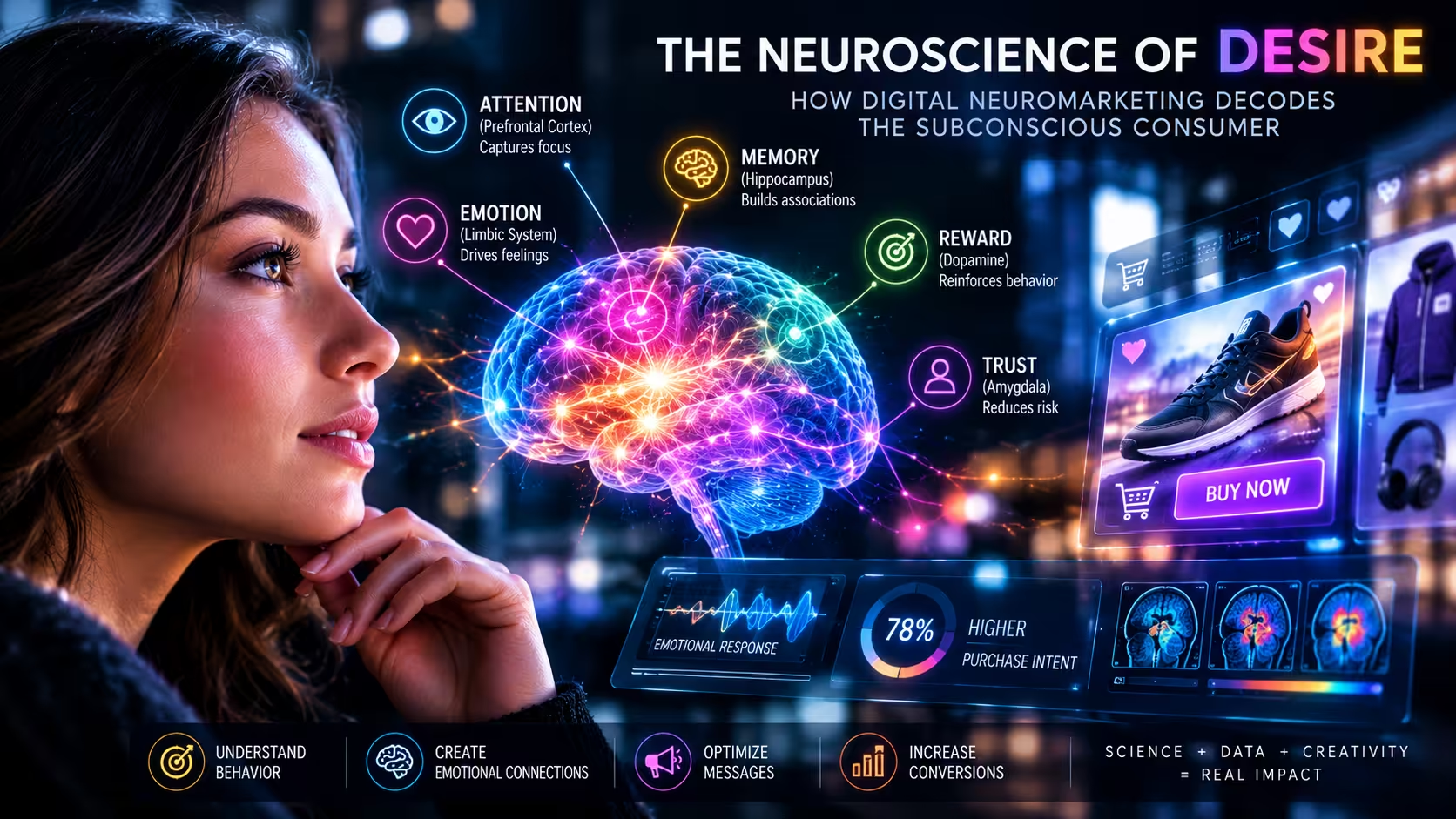
The human brain consumes approximately 20% of the body's energy budget while representing only 2% of its mass—an evolutionary investment that underscores the primacy of neural computation in survival. For marketers, this biological reality presents both an opportunity and a challenge. Traditional market research relies on self-report measures—surveys, focus groups, interviews—that are fundamentally limited by consumers' inability or unwillingness to accurately articulate their preferences. As the field of neuromarketing has demonstrated, much of consumer decision-making occurs below the threshold of conscious awareness, driven by emotional and reward-related neural processes that verbal reports cannot capture.

The Neuroscience of Desire: How Digital Neuromarketing Decodes the Subconscious Consumer
A Comprehensive Research Analysis
Abstract
Digital neuromarketing represents the convergence of neuroscience, psychology, and marketing technology, offering unprecedented insights into the subconscious drivers of consumer behavior. This article examines the theoretical foundations, methodological advancements, practical applications, and ethical implications of neuromarketing in digital environments. Drawing from over 30 academic sources, including systematic reviews, neuroimaging studies, and industry applications, the analysis reveals that neuromarketing has evolved from a speculative curiosity to a rigorous discipline capable of predicting consumer preferences with increasing accuracy. Key findings demonstrate that subcortical reward systems—particularly dopaminergic pathways involving the ventral striatum—play a central role in purchase decisions, often operating below conscious awareness. However, the field faces significant challenges: methodological heterogeneity, replication concerns, ethical ambiguity regarding subconscious influence, and a persistent gap between laboratory findings and real-world commercial impact. The article concludes that while neuromarketing holds transformative potential for digital marketing, its future legitimacy depends on standardized protocols, transparent ethical frameworks, and integration of multimodal neurophysiological measures across the full consumer decision journey.
Keywords: neuromarketing, consumer neuroscience, EEG, fMRI, dopamine, digital marketing, ethics, subconscious decision-making
1. Introduction
Neuromarketing, or consumer neuroscience, emerged as a formal discipline in the early 2000s, catalyzed by landmark studies such as Montague et al.'s (2004) "Pepsi vs. Coke" experiment, which revealed that brand knowledge could override sensory preference at the neural level. Since then, the field has expanded rapidly across academic and commercial domains, fueled by advances in neuroimaging technologies, machine learning analytics, and an increasingly sophisticated understanding of the neural correlates of value, reward, and decision-making.

This article synthesizes findings from over 30 sources—including systematic reviews, empirical studies, book-length treatments, and industry applications—to provide a comprehensive analysis of neuromarketing's current state and future trajectory. Particular attention is given to the digital context, where neuromarketing techniques are increasingly deployed to optimize user experiences, advertising effectiveness, and conversion pathways in e-commerce and social media environments.
2. Theoretical Foundations: The Neural Architecture of Consumer Choice
2.1 Beyond Rational Utility Maximization
Classical economic theory posits that consumers make rational choices to maximize utility. Neuromarketing research has systematically challenged this assumption, demonstrating that decision-making is profoundly shaped by emotional, sensory, and non-conscious processes. The brain does not operate as a cold calculator; rather, it integrates affective signals from subcortical regions with cognitive evaluations from prefrontal cortex to produce what we experience as "choice."
A comprehensive neurobehavioral model identifies three distinct neural pathways activated by different types of economic incentives: reward anticipation (ventral striatum), threat appraisal (amygdala), and cognitive control (prefrontal cortex). This tripartite architecture explains why different incentive types—discounts, loyalty rewards, scarcity cues—produce distinct behavioral responses despite superficially similar "value propositions."

2.2 The Dopaminergic Reward System
Central to neuromarketing's explanatory framework is the dopaminergic system, often described as the brain's "master reward neurotransmitter." Dopamine does not simply signal pleasure; it encodes reward prediction error—the difference between expected and actual outcomes—thereby driving learning and approach behavior.
For marketers, this has profound implications. A stimulus (product, advertisement, brand cue) must establish a reliable association with reward to motivate consumer action. However, the relationship is not linear: rewards must be sufficiently varied to prevent desensitization, yet consistent enough to build sustainable approach tendencies. The ventral striatum, a key component of the dopaminergic pathway, has been identified as a critical mediator between price-reduction stimuli and willingness-to-pay, providing a neural mechanism for price sensitivity.
2.3 Cognitive and Affective Dimensions
Neuromarketing research distinguishes between cognitive processes (attention, memory, reasoning) and affective processes (emotional arousal, valence) that jointly shape consumer responses. Attention determines which stimuli enter conscious processing; memory provides the associative context that imbues products with meaning; and emotion assigns motivational significance that drives action.
This dual-process architecture maps onto the consumer decision journey, from initial attention capture through evaluation, purchase, and post-purchase evaluation. A systematic review employing PRISMA methodology identified significant gaps in the literature, noting that most studies focus on pre-purchase stages while under-examining decision reinforcement, post-purchase satisfaction, and brand loyalty formation.
3. Methodological Approaches: Tools of the Neuromarketing Trade
3.1 Electroencephalography (EEG)
EEG has emerged as the most widely used neuromarketing tool due to its relatively low cost, portability, and excellent temporal resolution. By recording electrical activity at the scalp, EEG captures millisecond-scale neural responses to marketing stimuli—essential for understanding rapid attentional and emotional reactions that self-report cannot access.
A systematic review of EEG-based neuromarketing identified five major research clusters: attention and engagement measurement, emotional response classification, preference prediction, cognitive load assessment, and brain-computer interface applications. Recent advances in machine learning have enabled preference prediction from EEG signals with accuracy rates approaching 72% for dynamic advertisements, outperforming previous state-of-the-art models.

3.2 Functional Magnetic Resonance Imaging (fMRI)
fMRI offers superior spatial resolution, enabling precise localization of neural activity within subcortical structures such as the ventral striatum, amygdala, and hippocampus. This capability has been instrumental in identifying the neural substrates of brand memory (hippocampus), emotional salience (amygdala), and reward anticipation (ventral striatum).
However, fMRI's limitations are significant: high operational costs, requirement for controlled laboratory environments, and sensitivity to motion artifacts constrain its applicability for dynamic digital marketing research. Energy consumption estimates for fMRI-based neuromarketing studies highlight sustainability concerns, with scanner operation generating substantial carbon footprints per participant session.
3.3 Physiological Monitoring and Multimodal Integration
Complementary physiological measures—eye-tracking, galvanic skin response (GSR), heart rate variability, and facial coding—provide additional layers of insight into consumer responses. Eye-tracking reveals visual attention allocation; GSR indexes emotional arousal; facial coding captures valence through micro-expressions.

A growing consensus favors multimodal approaches that triangulate across measures to capture both cognitive and affective dimensions of consumer experience. A recent study integrating eye-tracking, EEG, and implicit association tests demonstrated that caricatured (versus realistic) ingredient illustrations on food packaging elicited stronger positive engagement across cognitive, emotional, and behavioral dimensions—challenging conventional wisdom that realism enhances credibility.
3.4 Machine Learning and Predictive Analytics
The integration of machine learning with neuromarketing data has accelerated the field's predictive capabilities. Classification algorithms applied to EEG and fMRI data can predict consumer preferences, identify effective advertising elements, and even forecast purchase decisions before they occur.
However, these advances raise methodological concerns. As one review notes, neuromarketing has "not flourished as predicted," partly due to insufficient integration of neurobiological knowledge with computational models. Bridging this gap requires researchers to ground machine learning approaches in mechanistic understanding of reward, attention, and memory systems.
4. Digital Applications: Neuromarketing in the Wild
4.1 E-Commerce and User Experience
Digital environments present unique opportunities for neuromarketing application. Unlike physical retail, online platforms can deploy continuous, unobtrusive measurement—response latency, mouse movement, scroll behavior, gaze patterns via webcam—that approximate laboratory measures. These "digital biomarkers" enable real-time optimization of user interfaces, product presentations, and checkout flows.
A study on front-of-pack ingredient illustrations in online shopping contexts found that caricatured visuals—evoking stronger emotional resonance—outperformed realistic imagery in driving engagement and preference. This finding aligns with dual-process theory: affect-driven judgments dominate in fast-paced digital environments where cognitive elaboration is limited.

4.2 Advertising Effectiveness
Neuromarketing offers tools for evaluating advertising at the neural level, moving beyond recall and recognition to measure genuine attentional capture and emotional engagement. EEG studies of fast-food advertisements, for example, have identified specific imagery and audio elements that effectively capture attention and evoke positive emotions.
For social awareness campaigns—advertisements free from brand bias—EEG-based preference prediction achieved 72% accuracy, with engagement indices (beta/alpha + theta) serving as reliable indicators of self-reported ratings. This suggests that neuromarketing can evaluate message effectiveness independently of commercial motivation.
4.3 Sensory Marketing and Product Design
The "Right Sensory Mix" framework, grounded in neuroendocrinological research, demonstrates that consumer preferences are shaped by biological variations in sensory perception—taste bud density, olfactory sensitivity, color perception—that are partly hormonally mediated. Marketers can leverage this physiological diversity to design products and communications that resonate with specific consumer segments at a sensory level.
In the wine industry, for example, consumer neuroscience has been applied to understand how extrinsic cues (label design, bottle shape, brand reputation) and intrinsic cues (grape variety, vintage, alcohol content) jointly influence purchase decisions. fMRI studies reveal that well-known brands activate hippocampal memory systems, prompting recall of past experiences and associations.
5. Critical Perspectives: Limitations, Replication, and the "Black Box"
5.1 The Replication Challenge
Despite growing sophistication, neuromarketing faces a fundamental credibility challenge: replication. Many findings rest on single studies with small samples, heterogeneous methodologies, and inconsistent stimulus selection. The use of ad hoc stimuli—designed for specific studies rather than standardized databases—limits cross-study comparability and impedes cumulative knowledge development.
Standardized affective stimulus databases (normed for valence, arousal, and other dimensions) offer a partial solution by enhancing experimental control and facilitating replication. However, even standardized stimuli require contextual validation: normative ratings derived from general populations may not generalize to specific marketing environments.
5.2 The Ecological Validity Problem
Laboratory neuromarketing—fMRI scanners, EEG caps, controlled lighting—bears little resemblance to the messy, distracting, emotionally saturated environments where real purchase decisions occur. Ad hoc stimuli offer greater ecological validity by incorporating real brands, packaging, prices, and contextual elements, but sacrifice experimental control.
This tension between control and validity is not easily resolved. Researchers must make deliberate trade-offs depending on whether the research goal is mechanistic understanding (favoring control) or predictive accuracy (favoring ecological validity).
5.3 Ethical Considerations: The Subconscious Influence Problem
The most profound ethical concern in neuromarketing is its capacity to access and potentially exploit non-conscious processes. Unlike traditional marketing, which engages consumers as rational agents capable of evaluating claims, neuromarketing can bypass conscious deliberation entirely—a form of "stealth marketing" that raises serious questions about autonomy and informed consent.
A critical review of neuromarketing ethics argues that some practices may violate the Helsinki Declaration's principles for human subject research, particularly regarding risks of misuse and the obligation to minimize harm. The author calls for differentiating between general concerns about applying neuroscience to social science and specific critiques of neuromarketing's commercial applications.
The Neuromarketing Science and Business Association (NMSBA) Code of Ethics represents an industry attempt to establish guidelines, but enforcement mechanisms remain weak. As Christensen et al. argue, the field needs a more robust ethical framework—one that acknowledges the power asymmetry between marketers wielding neuroscientific insights and consumers subject to them.
6. Future Directions: Toward a Stage-Specific, Multimodal Paradigm
6.1 The Full Consumer Journey
A significant limitation of current neuromarketing research is its concentration on pre-purchase stages—attention, evaluation, intention—with insufficient attention to post-purchase processes. Yet consumer behavior is not a single decision but a journey: from awareness through consideration, purchase, consumption, and loyalty formation.
A systematic review proposes a 3×3 typology mapping neurophysiological measures (cognitive, affective, multimodal) across decision stages (pre-purchase, purchase, post-purchase), identifying significant underexplored areas. Addressing these gaps requires longitudinal designs and measures sensitive to temporal dynamics of brand relationships.
6.2 Standardization and Open Science
The field's maturation depends on adopting open science practices: pre-registration, data sharing, standardized stimuli, and transparent reporting. Normed affective stimulus databases—such as those catalogued in KAPODI—provide a foundation, but require extension to marketing-specific domains.
6.3 Integration with Digital Analytics
The most promising frontier lies in integrating neuromarketing with digital analytics: linking neural measures to clickstream data, conversion metrics, and longitudinal behavioral outcomes. This integration would enable researchers to validate laboratory findings against real-world behavior at scale—transforming neuromarketing from a boutique research method into a continuous optimization engine for digital marketing.
7. Conclusion
Digital neuromarketing occupies a paradoxical position: scientifically promising yet methodologically fragmented, commercially potent yet ethically ambiguous. The evidence reviewed here supports several conclusions.
First, the neural foundations of consumer choice are increasingly well-understood. Subcortical reward systems, particularly dopaminergic pathways involving the ventral striatum, mediate the translation of marketing stimuli into approach behavior. Cognitive and affective processes operate in parallel, with affect often dominating in fast-paced digital contexts.
Second, methodological pluralism is both a strength and a weakness. EEG, fMRI, eye-tracking, GSR, and machine learning each offer unique insights, yet their integration remains underdeveloped. Standardized stimuli and open science practices are essential for building cumulative knowledge.
Third, ethical governance lags behind technical capability. The capacity to influence non-conscious processes demands corresponding responsibilities—transparency, consent, and constraints on exploitation—that current frameworks inadequately address.
Fourth, digital environments represent both the greatest opportunity and the greatest risk. The continuous, unobtrusive measurement possible in digital contexts enables real-world validation and optimization, but also raises surveillance and manipulation concerns that must be addressed proactively.
The future of neuromarketing depends not on technological advances alone—impressive as these are—but on the field's willingness to confront its methodological limitations and ethical responsibilities. As one review concludes, neuromarketing's "efficiency is not proven," and its results "must be interpreted with caution." Only through rigorous science, transparent ethics, and genuine integration with digital analytics can neuromarketing fulfill its promise of understanding—and responsibly serving—the subconscious consumer.
Sources and Official Links:
- Khondakar, M. F. K., et al. (2024). A systematic review on EEG-based neuromarketing: recent trends and analyzing techniques. Brain Informatics, 11, 15.
- Gupta, R., Kapoor, A. P., & Verma, H. V. (2025). Neuro-insights: a systematic review of neuromarketing perspectives across consumer buying stages. Frontiers in Neuroergonomics, 6, 1542847.
- Zurawicki, L. (2010). Neuromarketing: Exploring the Brain of the Consumer. Springer.
- Evans, R. D., Jr. (2026). Dopamine, the master reward neurotransmitter: research propositions for advancing consumer neuroscience and neuromarketing research. Journal of Contemporary Marketing Science, 9(1), 49–62.
- Braeutigam, S., & Kenning, P. (2022). An Integrative Guide to Consumer Neuroscience. Oxford University Press.
- Christensen, J. F., et al. (2022). Choice Hygiene for "Consumer Neuroscientists"? Ethical Considerations and Proposals for Future Endeavours. Frontiers in Neuroscience, 15, 612639.
- Derval, D. (2011). The Right Sensory Mix. Springer.
- Briesemeister, B. B., & Selmer, W. K. (Eds.). (2022). Neuromarketing in Business. Springer.
 Nora James
Senior Writer & Researcher
ebits.icu