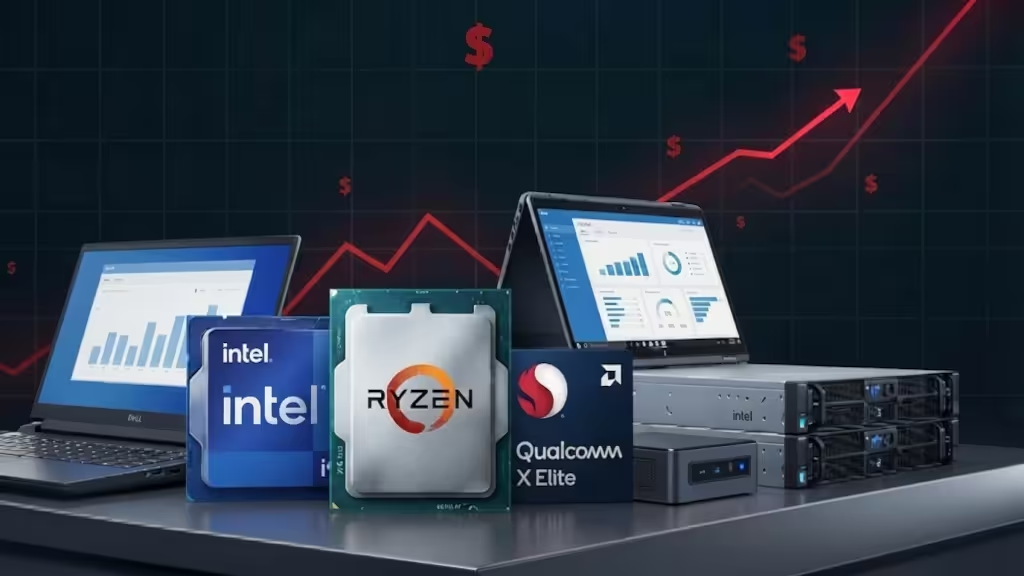
The PC hardware market is entering uncharted territory. After years of relatively stable pricing, the cost of desktop and laptop processors from AMD, Intel, and ARM-based vendors is set to climb significantly through 2026 and into 2027. The driving force is not a shortage of silicon wafers, nor a sudden surge in consumer demand — it is the relentless expansion of AI data centers. Here is what is happening and why your next CPU upgrade may cost you more than you expect.
This isn't a temporary spike. Multiple rounds of price increases have already been applied or announced, and industry analysts expect the pressure to continue well into 2027. For anyone building a PC, upgrading a workstation, or planning a fleet refresh, understanding the cause is the first step to making a smart buying decision. And it's not just CPUs: complete desktops, laptops, tablets, and even network servers are all caught in the same storm.
Intel: Three Rounds of Increases in 2026
Intel has been the most aggressive among the three major players. The company has already implemented three separate rounds of price increases throughout 2026, with the most recent one taking effect in October. The impact is visible in recommended pricing: the Core Ultra 7 270K Plus moved from $299 to $349, and the Core Ultra 5 250K Plus jumped from $199 to $229.

Behind these numbers is a stark reality: Intel has publicly acknowledged that its current production can only cover about 50% of the demand from its largest customers. Server-grade CPUs are being prioritized, which inevitably squeezes the supply available for consumer chips.
AMD: Consumer CPUs Up, Server CPUs Up More
AMD has followed a similar path, though with a different rhythm. Consumer CPUs have seen increases of up to 15% compared to the previous year, and a further 10% increase is expected in the fourth quarter of 2026 across several product lines. Server processors have risen even more sharply, with increases between 10% and 20% and cumulative growth that could exceed 16-17% over the course of 2026.

While AMD has not explicitly confirmed increases for its Ryzen consumer lineup in the next round, the broader trend suggests that consumer parts will not remain immune for long, especially as fabrication costs rise.
ARM and Qualcomm: The Silent Surcharge
ARM-based processors are not exempt. Qualcomm, the primary provider of ARM chips for Windows laptops, smartphones, wearables, and VR headsets, has notified its clients of a double-digit percentage increase starting in September 2026. This affects premium smartphones, wearables, VR headsets, and Windows on ARM laptops.

The message is clear: the ARM ecosystem is not a safe haven from the pricing storm. If anything, its dependence on advanced fabrication nodes makes it equally vulnerable to the same cost pressures.
The Real Cause: AI Is Bringing the CPU Back
For years, the AI narrative revolved around GPUs. Training large models required massive parallel compute, and GPUs were the obvious answer. But the landscape has shifted with the rise of agentic AI — systems that don't just answer a single query but execute continuous tasks: browsing, querying databases, managing files, calling APIs, coordinating processes.
All of that orchestration falls on the CPU. As a result, the CPU-to-GPU ratio in data centers is moving from 1:4 or 1:8 toward approximately 1:1, multiplying the demand for server-grade CPUs. When data centers need more CPUs, consumer supply shrinks. When supply shrinks, prices rise.

The Fabrication Bottleneck
There is a second layer to this story. Fabs, particularly TSMC, are saturated producing for AI, GPUs, and CPUs simultaneously on advanced nodes such as 3nm and 2nm. TSMC has notified its clients — including AMD, Qualcomm, Apple, and NVIDIA — of wafer price increases of around 10%, which are eventually passed down to the final product.

Building new fabs takes years. Until capacity catches up, the bottleneck will persist, and so will the price pressure.
The Ripple Effect: PC, Laptop, and Tablet Prices Are Rising Too
The CPU price increases are just one part of a much larger trend. The entire PC ecosystem, from complete desktops to laptops and tablets, is facing significant price hikes. The primary driver is the same AI-fueled demand for memory (DRAM) and storage (NAND flash).
Major manufacturers have confirmed this trend:
- Acer predicts that PC prices could rise by another 5% to 20% in Q4 2026, with the peak expected around mid-2027. Systems with more RAM and storage will see higher increases.
- ASUS has warned that laptop prices could increase by up to 30% due to higher component costs.
- Industry Analysis: Gartner estimates that combined DRAM and SSD prices could rise by 130% by the end of 2026, leading to a 17% increase in PC prices and a 13% increase in smartphone prices.

This creates a challenging situation: prices are rising while shipments are falling. Companies like HP and Dell are grappling with this "volume down, price up" dynamic, which squeezes their profit margins. HP has forecast that total PC sales in 2027 could fall by a mid-single-digit percentage worldwide. For consumers, this means the era of cheap, entry-level computers may be coming to an end, as manufacturers prioritize higher-end models to protect their profitability.

Outlook for 2027
The shortage and pricing pressure are expected to extend at least through 2027. No rapid relief is in sight. For 2027, the signals point to:
- Consumer Ryzen prices potentially rising as a knock-on effect of TSMC's wafer costs, even if AMD has not officially confirmed it.
- ARM laptops and PCs remaining more expensive, as Qualcomm has already raised prices and TSMC plans further increases in 2027.
- Continued growth in CPU demand for agentic AI, keeping pressure on both supply and pricing.
- Desktop, laptop, and tablet prices peaking around mid-2027, per Acer's projections.
- Entry-level computers becoming scarcer as manufacturers shift focus to premium models.

What This Means for Buyers
If you are planning to build or upgrade a PC with an AMD, Intel, or ARM-based CPU, the most sensible move — based on what every source indicates — is to buy before the next round of increases hits. Intel's next increase is already scheduled for October 2026, and AMD's fourth-quarter adjustment is expected shortly after. There is no indication that prices will fall in 2027; every signal points the other way.
For IT departments and system builders, this also means revisiting refresh cycles. Delaying a fleet upgrade by six months could mean paying significantly more for the same class of hardware. And for families looking to buy a laptop or tablet for school or work, buying sooner rather than later could save hundreds of dollars.
Conclusion: A New Pricing Reality
The era of cheap, abundant CPUs is facing its first real stress test. AI data centers have changed the economics of semiconductor manufacturing, and the consequences are reaching the consumer market. AMD, Intel, and ARM vendors are all raising prices, and the trend is expected to continue through 2027. The ripple effect now touches every device category: desktops, laptops, tablets, and even network servers.
Whether you are a gamer, a content creator, a developer, or an IT professional, the message is the same: plan ahead, buy strategically, and do not assume that waiting will save you money. In this market, waiting may cost you more.
 Dana Crandall
Technical Writer & Research Analyst
eBits Tech Platform
@ eBits.icu