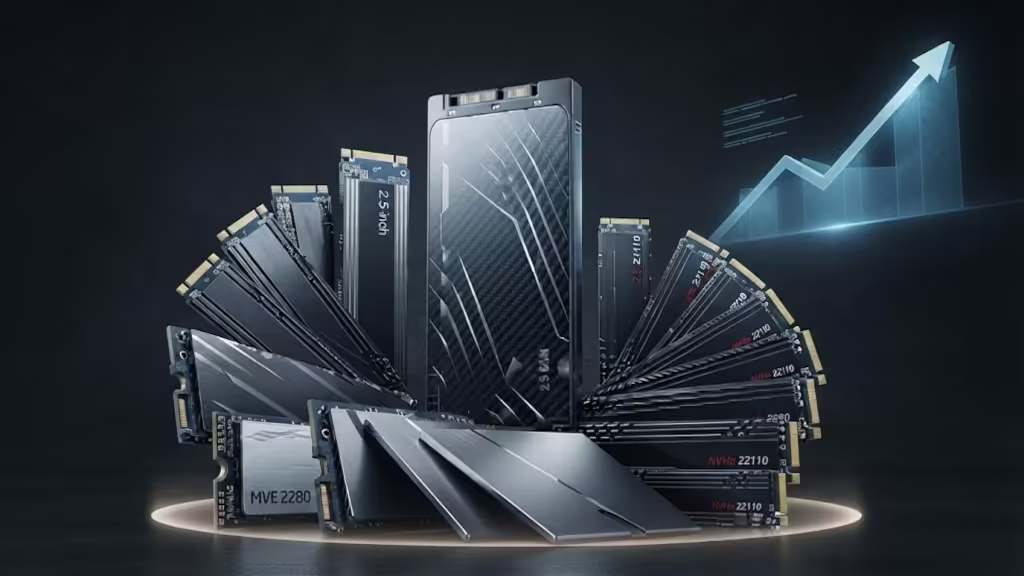
The solid-state drive (SSD) market is experiencing a seismic shift. After years of declining prices and increasing capacities, the cost of NAND flash storage — the fundamental component inside every SSD — has skyrocketed since late 2025 and continues to climb through 2026. The culprit is not a manufacturing accident, nor a sudden surge in consumer demand. It is the relentless, insatiable appetite of AI data centers. For anyone planning to upgrade a laptop, build a gaming PC, or expand a network-attached storage (NAS) system, understanding the forces at play is now essential.
This comprehensive analysis breaks down the technical, economic, and geopolitical factors driving the surge, and what it means for your wallet through 2027 and beyond.
The Numbers: How Much Are Prices Rising?
The scale of the increase is staggering. During the first quarter of 2026, basic 1TB SSDs without DRAM cache saw price increases of up to 147% compared to the previous quarter. This is not a gradual adjustment; it is a shock to the entire PC ecosystem.

Industry research firm TrendForce reported that NAND flash contract prices rose 10-15% in Q3 2026 alone, with enterprise SSD prices surging even more dramatically — 23-28% quarter-over-quarter in Q4 2026. For context, a 16GB DDR4 memory module that cost around $3.20 in late 2024 skyrocketed past $62 by December 2025.
The situation is so extreme that server-grade DDR5 DRAM is now more valuable by weight than gold. One 16GB DDR5 chip weighs roughly 0.2 grams, yet sells for an average of $53.93 — working out to approximately $269.70 per gram, compared to gold's $146.80 per gram at the time of writing. That is 1.84 times the price of gold, ounce for ounce.

The Root Cause: AI's Insatiable Demand for Storage
To understand why SSDs are getting more expensive, you must understand what changed in the AI industry during 2025 and 2026.
The first wave of AI investment focused on training large language models. This required massive GPU clusters and high-bandwidth memory (HBM). The second wave — which is now unfolding — focuses on inference and agentic AI. These systems do not just answer a single query; they execute continuous tasks: browsing, querying databases, managing files, calling APIs, and coordinating processes.

This shift has a profound implication: storage is no longer just storage. In modern AI data centers, enterprise SSDs are used to store the Key-Value (KV) cache — a critical component that allows AI models to maintain context during long conversations and complex reasoning tasks. Instead of storing this cache exclusively in expensive HBM, hyperscalers are offloading it to high-speed, high-capacity QLC enterprise SSDs.
A single AI server requires 8 to 10 times more DRAM than a standard server, and its storage needs scale proportionally. When OpenAI signed contracts for 4-5 million NVIDIA GPUs and 2.4 million AMD GPUs, the storage requirements for those deployments alone dwarfed the entire consumer SSD market.
The Enterprise SSD Boom
Cloud service providers (CSPs) have aggressively revised their enterprise SSD demand forecasts upward. TrendForce noted that total enterprise SSD orders in Q4 2026 could surpass the already elevated levels seen in Q3, maintaining a strong upward trajectory.

The demand is not limited to high-performance TLC (Triple Level Cell) SSDs. QLC (Quad Level Cell) storage — which stores 4 bits per cell instead of 3, offering higher capacity at lower cost — is seeing broader adoption in vector databases and AI inference systems. TrendForce projected that QLC enterprise SSDs will account for 18% of SSD capacity in 2026, rising to 38% in 2027.
JPMorgan projected that NAND bit demand will grow at an annual average of 20% and the market size at 34% over the next three years. By 2027, enterprise SSDs are expected to account for 48% of global NAND bit demand, overtaking smartphones (30%) and PCs (22%) to become the largest source of demand.
The Supply Side: Why Manufacturers Can't Keep Up
The supply chain for NAND flash is dominated by a handful of players: Samsung, SK hynix, Micron, Kioxia, and Western Digital. Together, they control the vast majority of global production. When AI demand surged, these manufacturers faced a choice: continue producing consumer-grade NAND at modest margins, or pivot to enterprise-grade SSDs and HBM with margins exceeding 60%.

The choice was obvious.
SK hynix allocated 75% of its DRAM capacity to HBM, while Samsung's HBM3E orders accounted for 82% of its total DRAM capacity. For NAND, the priority shifted to enterprise-grade QLC SSDs for AI data centers. Consumer-grade SSDs — the ones found in laptops, desktops, and external drives — were deprioritized.
This "capacity migration" has created a systemic supply gap in the consumer market. Manufacturers stopped accepting new orders for older, cheaper NAND generations. Samsung and Micron ceased taking new DDR4 orders in late 2025, planning to reduce DDR4 capacity to near zero. The same dynamic is playing out in the NAND market: older, cheaper SSD controllers and NAND dies are being phased out in favor of newer, more expensive enterprise-grade components.
The Capital Expenditure Paradox
Adding new capacity takes time — years, not months. SK hynix's planning documents indicate that new production capacity will not be released until 2028. In 2026, global DRAM wafer capacity is projected to grow by only about 1%.

The manufacturers learned a painful lesson during the 2022-2023 downturn. When prices crashed, Samsung recorded its lowest profit in 14 years. To avoid repeating that mistake, they are being extremely cautious about expansion. They are prioritizing technology upgrades over new capacity — a strategy that yields moderate supply growth while maintaining pricing discipline.
The Ripple Effect: What This Means for Consumers
The enterprise-focused supply strategy has a direct impact on consumer prices. When manufacturers allocate their best capacity to AI data centers, the remaining supply for consumer SSDs is smaller, older, and more expensive to produce.
PC and Laptop Prices
Acer CEO Jason Chen confirmed that PC prices could rise by 5% to 20% in Q4 2026, with the peak expected around mid-2027. Systems with more RAM and storage will see higher increases. ASUS has warned that laptop prices could increase by up to 30% due to higher component costs.

Gartner estimates that combined DRAM and SSD price increases could lead to a 17% increase in PC prices and a 13% increase in smartphone prices.
The Death of Entry-Level Computing
Perhaps the most concerning trend is the disappearance of affordable entry-level computers. With component costs rising, manufacturers are prioritizing higher-end models where profit margins are healthier. The sub-$500 laptop may become increasingly rare, and budget SSDs — the 1TB drives that once cost $50 or less — are now significantly more expensive.

For IT departments, this means revisiting refresh cycles. Delaying a fleet upgrade by six months could mean paying significantly more for the same class of hardware.
Timeline: When Will Prices Stabilize?
The outlook is not uniformly bleak, but the road to stability is long.
2026: Continued Increases
Through the remainder of 2026, expect SSD and RAM prices to keep rising. TrendForce projects NAND flash contract prices to increase 15-20% in Q4 2026, with enterprise SSDs leading the surge. Consumer-grade SSDs will see more modest increases — typically 8% quarter-over-quarter for PCIe 4.0 drives — but the direction is uniformly upward.
2027: The Peak and the Pivot
Acer's Jason Chen expects prices to peak around mid-2027 before beginning a gradual decline in the second half of the year. The Bank of America forecasts that DRAM and NAND average selling prices will remain elevated through 2027, then decline by about 10% in 2028 (DRAM down 5%, NAND down 13%) — a "soft landing" before the next growth cycle.

The key variable is Chinese production. CXMT (ChangXin Memory Technologies) already accounted for 10% of global DRAM revenue in Q2 2026, and YMTC has expanded its presence in the NAND market. If CXMT's planned second DRAM fab and NAND production lines come online, total capacity could reach 600,000 wafers per month — enough to meaningfully ease supply pressures.
2028-2030: The Long-Term Outlook
The memory market is projected to reach $2 trillion in total value by 2030, driven by structural AI demand. Long-term supply agreements between hyperscalers and memory manufacturers — some spanning 3-5 years — will smooth out the boom-bust cycles of the past, but they also lock in higher prices for the foreseeable future.

What This Means for Buyers
If You Need Storage Now
Buy sooner rather than later. Every source indicates that prices will continue rising through at least mid-2027. A 1TB SSD that costs $100 today could cost $130 or more by the end of the year. For anyone planning a PC build or laptop purchase, waiting is likely to cost you more.
If You Can Wait
The second half of 2027 is the earliest realistic window for price stabilization. If your storage needs are not urgent, holding off until late 2027 or 2028 could save you significant money. The expansion of Chinese production capacity is the wild card that could accelerate the timeline.
For IT Professionals
Revisit your hardware refresh cycles. With enterprise SSD prices surging 23-28% quarter-over-quarter, delaying a fleet upgrade by even a few months could mean paying substantially more. Consider locking in long-term supply agreements with your vendors if your organization's storage needs are predictable.
Conclusion: A New Storage Reality
The era of cheap, abundant storage is facing its first real stress test. AI data centers have fundamentally changed the economics of NAND flash manufacturing, and the consequences are reaching every corner of the consumer market. SSDs, RAM, and the devices that depend on them are all getting more expensive.
The good news is that this is not a permanent condition. New capacity is coming, Chinese manufacturers are expanding, and the industry is investing in technology that will eventually bring costs down. But the timeline is measured in years, not months.
For now, the message is clear: if you need storage, buy it. If you can wait, wait — but be prepared to wait until 2028 for prices to return to anything resembling normal.
 Dana Crandall
Technical Writer & Research Analyst
eBits Tech Platform
@ eBits.icu