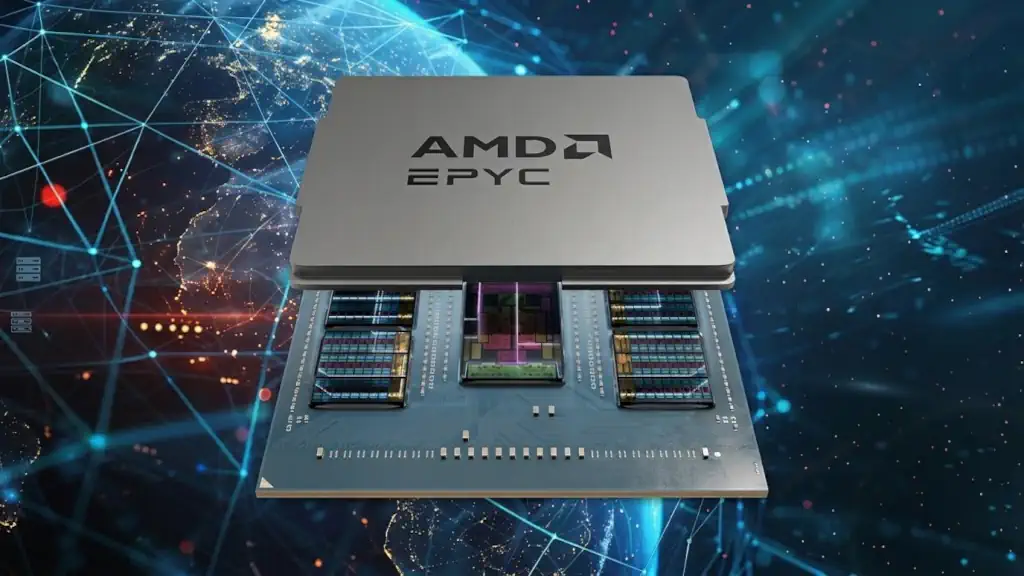
AMD EPYC processors have redefined the server market, challenging Intel's dominance and setting new performance and efficiency standards. The EPYC 9005 "Turin" series, based on the new Zen 5 architecture, offers up to 192 cores with enhanced instruction sets, while the EPYC 8005 "Sorano" line addresses power-constrained environments. The AMD EPYC lineup is arguably the most disruptive force in the data center today.
With revenue share hitting a record 46.2% in Q1 2026, AMD is not just competing, it's winning. The secret sauce is a multi-generational strategy that combines aggressive core counts, efficient architecture, and a relentless focus on the needs of modern workloads from cloud-native to AI.
This complete guide explores the full AMD EPYC ecosystem, dissecting each platform's architecture, specifications, performance, and market position.
The AMD EPYC Ecosystem: A Platform for Every Workload
The Flagship: EPYC 9005 "Turin" — The King of Performance
Introduced in late 2024, the EPYC 9005 series represents AMD's flagship data center offering . Built on the **Zen 5 architecture**, Turin is designed to handle the most demanding workloads, from high-performance computing (HPC) to intensive AI orchestration .
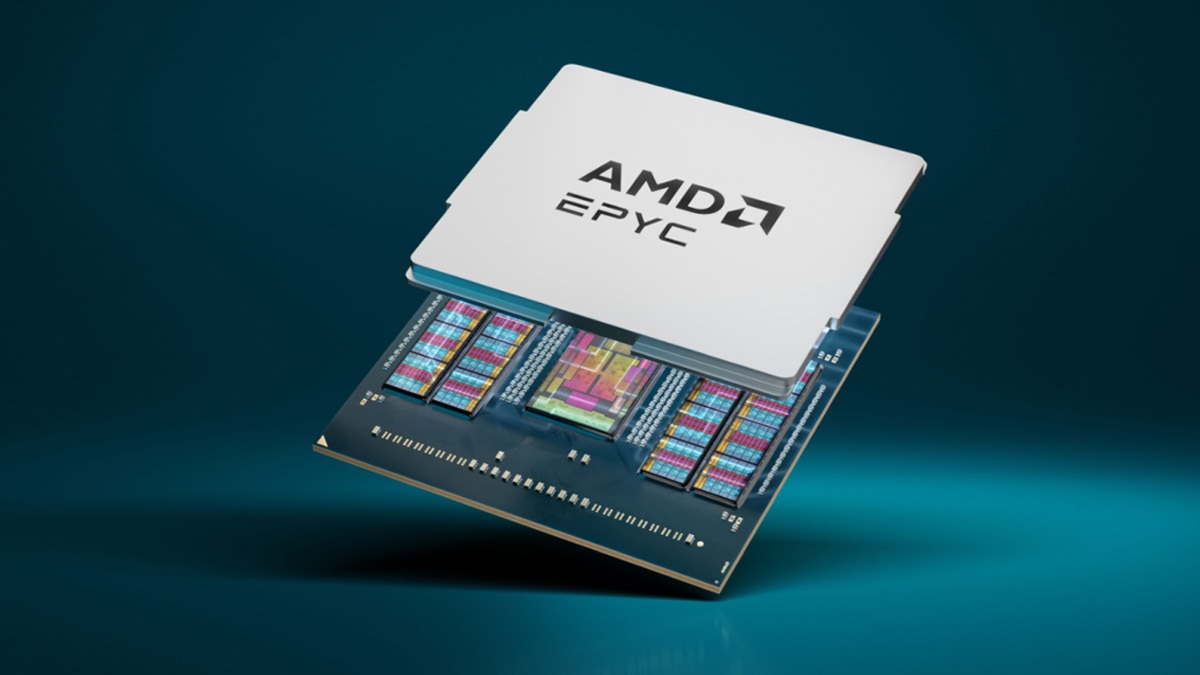
The Turin family includes two main chiplet designs:
- Zen 5 (Standard): Uses up to 16 4nm CCDs, each with 8 cores, for a maximum of 128 cores .
- Zen 5c (High-Density): Uses up to 12 3nm CCDs, each with 16 cores, for a maximum of **192 cores** .
AMD claims a significant **17% increase in Instructions Per Cycle (IPC)** for Turin, driven by the Zen 5 architecture . A notable addition is support for a **full 512-bit AVX-512 datapath**, which is a game-changer for scientific computing and AI inference workloads .
The Power-Efficient Champion: EPYC 8005 "Sorano"
Launched in May 2026, the EPYC 8005 "Sorano" series is a single-socket processor designed for power and space-constrained environments like edge computing, telecommunications (vRAN), and cloud storage . The key innovation is the exclusive use of full **Zen 5 cores**, completely ditching the "c" variants .

At the top of the stack is the **EPYC 8635P**, featuring 84 cores and 168 threads . Despite the core count, it operates within a **225W TDP**, delivering up to **40% higher integer performance** and **9.5% better performance per watt** than its predecessor . The platform supports six channels of DDR5-6400 memory .
The Entry Point: EPYC 4004 Series
For smaller businesses or white-box servers, the EPYC 4004 series offers an entry point . The top model, EPYC 4584PX, is a 16-core Zen 4 processor with a massive 128 MB L3 cache, fitting the **AM5 socket** and supporting DDR5 memory .
The Next Frontier: EPYC 9006 "Venice"
The future of AMD EPYC is the 6th-generation "Venice" series, announced in mid-2026 . Venice will feature up to **256 cores** and introduce **PCIe Gen 6** for dramatically improved I/O bandwidth .
Ecosystem and Architecture Deep Dive
The EPYC platform is built on a robust architecture designed to deliver consistent, high-performance scalability .
- Memory and I/O: Each EPYC 9005 CPU supports up to 12 channels of DDR5 memory, with speeds up to **6400 MT/s** . The platform provides **128 PCIe Gen 5 lanes** for single-socket servers and 160 lanes in dual-socket configurations .
- CXL 2.0: A key innovation is support for **CXL 2.0**, allowing memory expansion devices to be attached via the PCIe bus .
Market Position and Performance
The success of the EPYC platform is evident in market data. Mercury Research reports that AMD's server CPU revenue share hit a record **46.2%** in Q1 2026 . While Intel leads in unit share (66.8%), the revenue gap is a testament to AMD's pricing power and high-value EPYC chips .
Conclusion: The EPYC Era
AMD EPYC is no longer just a challenger. It is a market leader. The combination of high core counts, advanced performance, and clear product segmentation has forced Intel to play catch-up. AMD EPYC is likely to remain the top choice for businesses building modern, high-performance, and efficient data centers.
 Maya Swanson
Embedded Systems Engineer & Technical Writer
eBits Tech Platform
@ eBits.icu