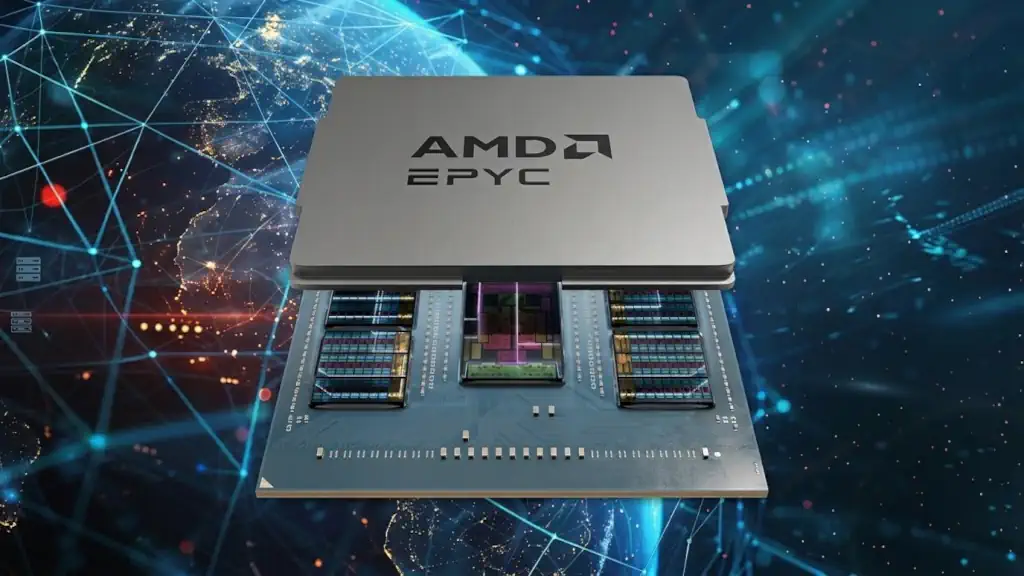
AMD EPYC processors have redefined the server market, challenging Intel's dominance and setting new performance and efficiency standards. The EPYC 9005 "Turin" series, based on the new Zen 5 architecture, offers up to 192 cores with enhanced instruction sets, while the EPYC 8005 "Sorano" line addresses power-constrained environments. The AMD EPYC lineup is arguably the most disruptive force in the data center today.
With revenue share hitting a record 46.2% in Q1 2026, AMD is not just competing, it's winning. The secret sauce is a multi-generational strategy that combines aggressive core counts, efficient architecture, and a relentless focus on the needs of modern workloads from cloud-native to AI.
This complete guide explores the full AMD EPYC ecosystem, dissecting each platform's architecture, specifications, performance, and market position.
The AMD EPYC Ecosystem: A Platform for Every Workload
AMD has segmented its EPYC lineup into clear tiers to address different market needs. The flagship 9005 "Turin" series dominates high-performance computing, while the 8005 "Sorano" series focuses on power efficiency, and the 4004 series targets entry-level and white-box servers. Each platform is optimized for specific workloads, from AI inference and cloud-native applications to telecommunications and edge computing.
The Flagship: EPYC 9005 "Turin" — The King of Performance
Introduced in late 2024, the EPYC 9005 series represents AMD's flagship data center offering. Built on the Zen 5 architecture, Turin is designed to handle the most demanding workloads, from high-performance computing (HPC) to intensive AI orchestration [citation:6][citation:11].
The Turin family includes two main chiplet designs:
- Zen 5 (Standard): Uses up to 16 4nm CCDs, each with 8 cores, for a maximum of 128 cores [citation:1][citation:6].
- Zen 5c (High-Density): Uses up to 12 3nm CCDs, each with 16 cores, for a maximum of 192 cores [citation:1][citation:6].
AMD claims a significant 17% increase in Instructions Per Cycle (IPC) for Turin, driven by the Zen 5 architecture. A notable addition is support for a full 512-bit AVX-512 datapath, which is a game-changer for scientific computing and AI inference workloads [citation:1][citation:6].
In practical terms, a single AMD EPYC 9965-based server can replace more than eight legacy Intel Xeon Platinum 8280 servers from 2019, significantly reducing data center footprint, power consumption, and software licensing costs.
The Power-Efficient Champion: EPYC 8005 "Sorano"
Launched in May 2026, the EPYC 8005 "Sorano" series is a single-socket processor designed for power and space-constrained environments like edge computing, telecommunications (vRAN), and cloud storage [citation:2][citation:7]. The key innovation is the exclusive use of full Zen 5 cores, completely ditching the "c" variants.
At the top of the stack is the EPYC 8635P, featuring 84 cores and 168 threads [citation:2][citation:7]. Despite the core count, it operates within a 225W TDP, delivering up to 40% higher integer performance and 9.5% better performance per watt than its predecessor [citation:7][citation:12]. The platform supports six channels of DDR5-6400 memory [citation:7].
The Entry Point: EPYC 4004 Series
For smaller businesses or white-box servers, the EPYC 4004 series offers an entry point. The top model, EPYC 4584PX, is a 16-core Zen 4 processor with a massive 128 MB L3 cache, fitting the AM5 socket and supporting DDR5 memory. This platform is ideal for on-premises servers, edge appliances, and cost-sensitive deployments where high core counts are not required.
The Next Frontier: EPYC 9006 "Venice"
The future of AMD EPYC is the 6th-generation "Venice" series, announced in mid-2026 [citation:3][citation:8]. Venice will feature up to 256 cores and introduce PCIe Gen 6 for dramatically improved I/O bandwidth [citation:3][citation:8].
The new SP7 platform will support 16 channels of DDR5-8000 memory, enabling unprecedented memory bandwidth for AI, HPC, and memory-intensive workloads [citation:8]. Early benchmarks show Venice delivering up to 3.7× performance on NGINX and 2.9× on Redis compared to previous generations [citation:3].
Ecosystem and Architecture Deep Dive
The EPYC platform is built on a robust architecture designed to deliver consistent, high-performance scalability.
- Memory and I/O: Each EPYC 9005 CPU supports up to 12 channels of DDR5 memory, with speeds up to 6400 MT/s [citation:1]. The platform provides 128 PCIe Gen 5 lanes for single-socket servers and 160 lanes in dual-socket configurations.
- CXL 2.0: A key innovation is support for CXL 2.0, allowing memory expansion devices to be attached via the PCIe bus.
- Security: AMD EPYC processors feature advanced security capabilities including Secure Memory Encryption (SME) and Secure Encrypted Virtualization (SEV), protecting data both at rest and in transit [citation:11].
Market Position and Performance Leadership
The success of the EPYC platform is evident in market data. Mercury Research reports that AMD's server CPU revenue share hit a record 46.2% in Q1 2026 [citation:5][citation:10][citation:15]. While Intel leads in unit share (66.8%), the revenue gap is a testament to AMD's pricing power and high-value EPYC chips [citation:5].
In performance benchmarks, 5th Gen AMD EPYC CPUs consistently outperform Intel Xeon 6 processors:
- General computing: AMD EPYC beats Intel Xeon by up to 35% on SPECrate 2017_int_base [citation:4][citation:9].
- Power efficiency: AMD EPYC is up to 66% more power efficient than Xeon on SPECpower_ssj 2008 [citation:4].
- AI inference: EPYC 9965 delivers up to 1.33x more throughput on Llama3.1-8B translation workloads than Intel Xeon 6980P [citation:4].
- Machine learning: EPYC 9965 delivers up to 1.93x more throughput on XGBoost than Intel Xeon 6980P [citation:4].
- End-to-end AI: EPYC 9965 delivers up to 1.7x more throughput on TPCx-AI than Intel Xeon 6980P [citation:4].
Cloud and OEM Adoption
Every major cloud provider—AWS, Microsoft Azure, Google Cloud, Oracle Cloud—offers AMD EPYC-based instances. Leading OEMs including Dell, HPE, Lenovo, Supermicro, and Cisco build systems around EPYC processors. In fact, the top 10 Fortune 100 companies use AMD EPYC processors in their data centers, with Fortune 500 adoption continuing to accelerate.
Conclusion: The EPYC Era
AMD EPYC is no longer just a challenger. It is a market leader. The combination of high core counts, advanced performance, and clear product segmentation has forced Intel to play catch-up. AMD EPYC is likely to remain the top choice for businesses building modern, high-performance, and efficient data centers.
Whether you're consolidating legacy infrastructure, deploying AI workloads, or optimizing cloud-native applications, AMD EPYC offers a compelling solution that balances performance, power efficiency, and total cost of ownership.
Sources and Official Links
 Grace Sterling
Embedded Systems Engineer & Technical Writer
eBits Tech Platform
@ eBits.icu