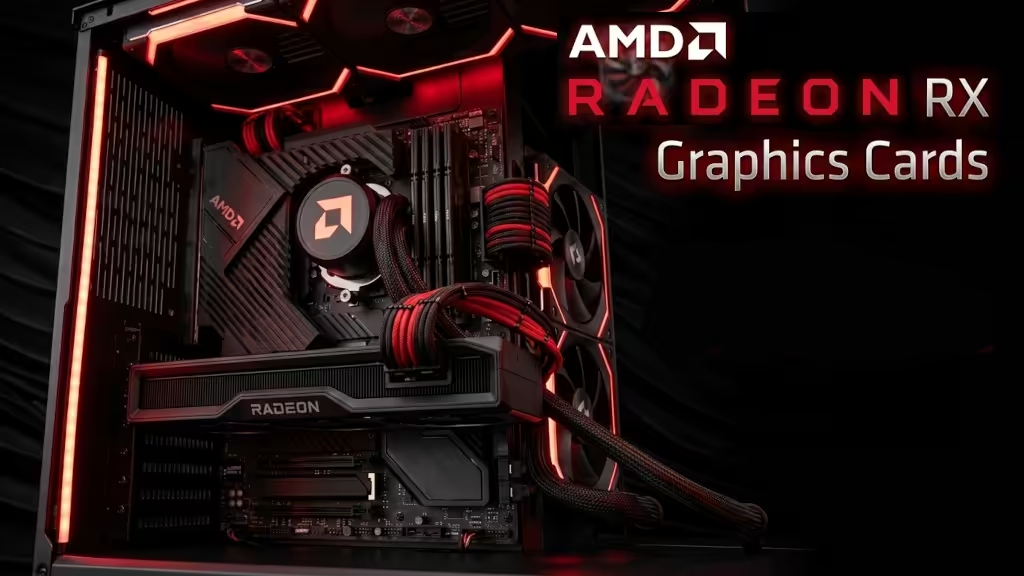
AMD Radeon RX graphics cards have evolved into a comprehensive ecosystem spanning multiple generations, from the budget-friendly RX 6000 series to the cutting-edge RDNA 4-powered RX 9000 lineup. Whether you're a gamer chasing 4K frames, a content creator needing VRAM for large projects, or a student on a budget, there's a Radeon RX card for you in 2026. Find out which one is for you !
The Radeon RX series has grown into a complete portfolio that now covers every price point and performance tier. The introduction of the entry-level RX 9050 has completed the RDNA 4 lineup, while the RDNA 3-based RX 7000 series continues to offer excellent value, and the RDNA 2-based RX 6000 series remains a viable option for budget-conscious builders.
This comprehensive guide draws from extensive hands-on testing by TechRadar, Tom's Hardware, PC Gamer, and GeekOM PC, covering performance benchmarks, architectural details, pricing analysis, and market positioning for every major Radeon RX card available in 2026.
The AMD Radeon RX Ecosystem: A Generational Overview
AMD's Radeon RX family is organized by architecture, with each generation targeting a specific tier of performance and value. The RDNA 4 architecture powers the new RX 9000 series, which now covers the entire stack from the flagship RX 9070 XT to the entry-level RX 9050. The RDNA 3 architecture drives the RX 7000 series, still a strong performer for 1440p and 4K gaming. The RDNA 2 architecture powers the RX 6000 series, which offers a budget-friendly entry point with competitive 1080p and 1440p performance.
RDNA 4: The RX 9000 Series — Complete Lineup
The RX 9000 series is built on the AMD RDNA 4 architecture, featuring significant improvements in ray tracing, AI performance, and overall efficiency. This series now includes a full range of models from flagship to entry-level.
| Model | Compute Units | Stream Processors | VRAM | Memory Interface | Target Resolution | Price (MSRP / Street) |
|---|---|---|---|---|---|---|
| RX 9070 XT | 64 | 4096 | 16GB GDDR6 | 256-bit | 4K Ultra | $599 / ~$700-730 |
| RX 9070 | 56 | 3584 | 16GB GDDR6 | 256-bit | 4K | $549 / ~$600-630 |
| RX 9070 GRE | 48 | 3072 | 12GB GDDR6 | 192-bit | 1440p/4K | ~$500-550 |
| RX 9060 XT (16GB) | 32 | 2048 | 16GB GDDR6 | 128-bit | 1440p | $349 / ~$440-470 |
| RX 9060 XT (8GB) | 32 | 2048 | 8GB GDDR6 | 128-bit | 1440p | $299 / ~$350-370 |
| RX 9050 (8GB) | 16 | 1024 | 8GB GDDR6 | 128-bit | 1080p | ~$279 |
Flagship Performance: RX 9070 XT
The RX 9070 XT is the performance king of the Radeon lineup. According to TechRadar's testing, it delivers performance that often matches or even beats the Nvidia GeForce RTX 4080 while launching at just half the MSRP, making it the most compelling value on the market.
In real-world gaming, it achieves 82 FPS in Call of Duty: Black Ops 7 and 73 FPS in Arc Raiders at 4K. Peak power draw can hit 309W, and you'll need room for a triple-fan cooler.
The Value King: Radeon RX 9070
PC Gamer's Dave James calls the RX 9070 the best graphics card of 2026. It offers close to the performance of the XT version, comfortably beats the RTX 5070, and can be overclocked to within 2% of the XT's performance. At 1440p, it delivers 73 FPS average with a 64 FPS 1% low, outperforming the RTX 5070's 68/60 FPS.
The RX 9070 is particularly compelling when considering its power efficiency, with a peak power draw of only 270W and a 4K frame per joule rating of 0.26, matching the RTX 5070 Ti's efficiency.
The Entry-Level: RX 9050
The newly released RX 9050 completes the RX 9000 series as an entry-level 1080p gaming card. It features 16 RDNA 4 compute units (1024 stream processors) and is available in 8GB and 4GB configurations. The 8GB version is aimed at the retail market with a price of $279 USD, while the 4GB version is exclusive to OEMs and system integrators. The 4GB version has a cut-down 64-bit memory bus, reducing bandwidth to 144 GB/s and making it suitable only for light tasks or entry-level builds.
RDNA 3: The RX 7000 Series
The RX 7000 series, based on RDNA 3, remains a strong performer. The RX 7900 XTX is a 4K gaming powerhouse with 24GB of VRAM, while the RX 7800 XT and RX 7700 XT offer excellent 1440p performance. The RX 7600 series is the entry point for 1080p gaming. The RX 7900 XTX offers up to 24GB of VRAM, making it suitable for high-resolution textures and content creation.
According to Tom's Hardware's testing, the RX 7900 XTX still holds its own at 4K, delivering an average of 80 FPS across tested titles, and is well-priced for a premium card.
RDNA 2: The RX 6000 Series
The RX 6000 series, based on RDNA 2, continues to be a viable option for budget-conscious gamers. The RX 6600 is a popular choice for 1080p gaming, offering a good balance of performance and price. The RX 6700 XT and RX 6800 XT provide excellent 1440p gaming performance and are often available at attractive prices.
GeekOM PC's Real-World Performance Tests
Testing at 1440p high settings reveals the following performance figures:
| GPU | Cyberpunk 2077 | Hogwarts Legacy | Dying Light 2 | Shadow of the Tomb Raider |
|---|---|---|---|---|
| RX 7600 | 60 FPS | ~45 FPS | 52 FPS | ~58 FPS |
| RX 7700 XT | 95 FPS | 67 FPS | ~85 FPS | ~95 FPS |
| RX 7800 XT | 107 FPS | 111 FPS | ~105 FPS | 167 FPS |
| RX 9060 XT | 77 FPS | ~70 FPS | 54 FPS | ~92 FPS |
| RX 7900 XTX | 135 FPS | ~140 FPS | ~105 FPS | ~186 FPS |
| RX 9070 XT | 125 FPS | ~115 FPS | ~106 FPS | ~106 FPS |
The numbers show that the RX 7600 gives you a smooth 60 FPS experience, while the RX 7700 XT and higher give you plenty of room for high-refresh-rate gaming. In a 1440p environment, the newer RX 9070 XT can consistently keep over 100 FPS.
Integrated Radeon Graphics: The APU Advantage
AMD's Ryzen APUs (Accelerated Processing Units) have GPUs built in, such as the Radeon 780M and Radeon 890M. These are very different from the old integrated graphics that were "just for display output." They offer enough speed to enjoy many light games.
With its RDNA 3.5 architecture, the newest Radeon 890M can play many games at 1080p and medium settings. Since it is an integrated GPU, it shares system memory (DDR5) instead of having its own VRAM. This lets you assign memory in different ways.
Take a look at how well integrated Radeon GPUs work, which are common in mini PCs and laptops. Here are some real-life tests done at 1080p low settings:
| GPU | CS:GO2 | Dota 2 | Practical Use Cases |
|---|---|---|---|
| Radeon 890M | 230 FPS | 109 FPS | All esports & lightweight games |
| Radeon 780M | 218 FPS | 143 FPS | Great for esports & daily use |
| Intel Iris Xe G7 (96 EU) | 115 FPS | 94 FPS | Suitable for lightweight titles |
FSR 4: The AI Upscaling Advantage
AMD's FSR 4 offers AI-enhanced upscaling with superior image quality to other FSR versions, but official support for it is limited to RX 9000-series Radeons for now. AMD will bring FSR 4 upscaling to RX 7000-series cards in July 2026 and RX 6000-series cards in early 2027. In the meantime, AMD's FSR 3.1 and earlier upscalers still work on any GPU, but the image quality tends to be noticeably lower than both DLSS and FSR 4.
AI-enhanced FSR framegen (aka ML Frame Generation) arrived on AMD cards as part of the FSR Redstone update late last year. Like FSR 4 upscaling, ML Frame Generation is limited to Radeon RX 9000 cards, and it can be enabled in compatible games using a control panel override for titles that don't natively have it.
The "Avoid Radeon" Myth: A 2026 Reality Check
The "avoid Radeon" reputation stems from driver issues between 2018-2020. Those days are largely behind us. Drivers released after late 2024 (version 24.9.1 and later) have fixed major bugs and offer stability that is now industry-standard.
Game compatibility has also improved significantly. Radeon issues are not common in new games coming out in 2026, and games based on DirectX and Vulkan do not have any issues. Upscaling quality has also gotten a lot better since FSR 4 came out.
However, ray tracing performance, while improved, still lags behind Nvidia's latest offerings. CUDA-dependent AI tools can also be more complex to set up on Radeon.
Pre-Purchase Checklist
- Check Your Monitor Resolution: RX 7600 for 1080p/60Hz, RX 7700 XT for 1440p/144Hz, RX 7900 series for 4K gaming.
- Verify Your Power Supply: RX 7600 needs a 500W PSU; RX 7900 XTX needs 850W+.
- Desktop PC or Mini PC? Dedicated GPUs require case space and PSU capacity. For compact builds, consider a mini PC with integrated Radeon graphics.
- Check Your Main Software: Radeon works great for gaming and Blender, but research compatibility carefully if you rely heavily on Adobe software.
- Don't Fixate on VRAM Alone: "16GB = safe" is a common misconception. Always verify that GPU performance matches your resolution and the games you play.
- Look for Clearance & Older Models: A discounted RX 7000 series card may outperform a new entry-level RX 9000 series. High-end cards from 2-3 years ago often beat today's budget options.
Conclusion
The AMD Radeon RX lineup offers a compelling choice for every budget and use case. The new RDNA 4-based RX 9000 series brings cutting-edge features and performance, while the RX 7000 and RX 6000 series continue to offer strong value. The RX 9050 now completes the RX 9000 family, providing a genuine entry-level option for 1080p gaming. Whether you're building a 4K gaming rig or an affordable 1080p system, there is a Radeon RX graphics card designed for your needs.
For most PC gamers, the RX 9070 stands out as the best overall choice, offering high-end 1440p performance and the ability to overclock close to the XT's level, all at a price that undercuts Nvidia's comparable offerings.
Official Sources and Downloads
- AMD Radeon RX Graphics Cards Official Page
- TechRadar's Best AMD Graphics Cards Guide
- Tom's Hardware Best Graphics Cards Guide
- PC Gamer's Best Graphics Cards Guide
- GeekOM PC's AMD Radeon Buying Guide
 Grace Sterling
Embedded Systems Engineer & Technical Writer
eBits Tech Platform
@ eBits.icu