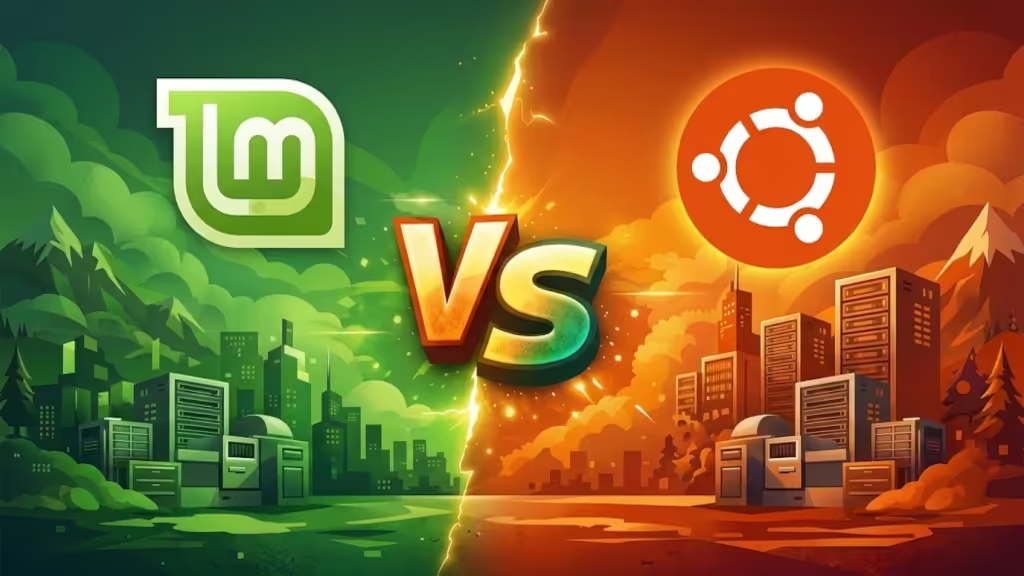
Linux newcomers in 2026 have a much easier time now. You no longer need to install Linux with one hand on a wiki page and the other hand praying to the bootloader gods. Most major distros now install cleanly, detect hardware well, and give you a working desktop in under 30 min. Ubuntu is the most famous one. It is the name you see in tutorials, developer guides, cloud documentation, and YouTube videos.
Linux Mint is the quieter recommendation. It is the distro people suggest when someone says, "I want Linux, but I also want my laptop to behave like a normal computer" [citation:1].
Both are good, which makes the choice tricky. Ubuntu 26.04 LTS brings a newer long-term support base, a polished GNOME desktop, and strong ecosystem support. Linux Mint 22.x continues Mint's usual focus on stability, familiarity, and desktop comfort [citation:1].
So the question is not really which distro is more impressive but which one makes the first week on Linux less annoying [citation:1].
First Impressions: Familiarity vs. Modernity
Linux users sometimes forget how strange a new desktop can feel. We will tell you to "just open the terminal" as if the terminal is a household appliance, somewhere between the kettle and the toaster. For a newcomer, those first few hours are important. That is when they decide whether Linux feels usable or whether it feels like homework [citation:1].
Linux Mint understands this better than most distros. Its Cinnamon desktop looks close enough to the traditional Windows layout that most people can understand it almost immediately. There is a panel at the bottom, a menu in the corner, system icons on the right, and windows behave the way people expect. You can minimize things, maximize things, right-click things, pin apps, drag files, and generally move around without wondering why the desktop is trying to teach you a philosophy seminar [citation:1].
Ubuntu uses GNOME with Canonical's own extensions and visual style. It can feel elegant once you get used to it. The Activities overview, app grid, dock behavior, search-first workflow, and virtual desktops all make sense after some adjustment. The problem is that newcomers do not always want adjustment on day one. Someone coming from Windows may find Ubuntu perfectly usable, but also slightly alien. It is not difficult in the sense that it blocks you from doing things. It is difficult in the sense that it keeps asking you to think about how the desktop wants to be used [citation:1][citation:4].
Installing Software: The Snap vs. Flatpak Debate
One of the first real tests for a new Linux user is installing apps. The old Linux experience often involved package names, repositories, terminal commands, and someone on a forum telling you to compile from source with the confidence of a man recommending home surgery. Thankfully, both Ubuntu and Mint now have graphical software stores. You can search for apps, click install, and avoid typing commands for basic tasks. That alone is a huge improvement [citation:1].
Ubuntu leans heavily on Snap packages. Snaps have real advantages in that they can be easier for developers to ship across different Linux distros, and Canonical has spent years improving their security, permissions, and desktop integration. Ubuntu 26.04 also continues to improve how these apps fit into GNOME settings and system permissions [citation:1].
Still, Snap remains one of the more divisive parts of Ubuntu desktop life. Some apps open a little slower, some users dislike the centralization around Canonical's Snap Store, and some beginners get confused when they see different packaging formats discussed online and have no idea why Firefox has suddenly become a political issue (welcome to Linux, please take a side) [citation:1].
Linux Mint's Software Manager feels simpler for newcomers. Mint uses Ubuntu packages underneath, supports Flatpak out of the box, and presents software in a way that feels closer to a normal app store. You search, install, and move on. That sounds boring, but boring is exactly what a software manager should be [citation:1][citation:8].
Ubuntu's approach may make more sense if you care about Canonical's wider packaging strategy. Mint's approach makes more sense if you just want VLC, Spotify, LibreOffice, Steam, or an image editor without being invited into a debate about sandboxing [citation:1].
System Updates: Trust and Safety
New Linux users are often afraid of updates. They have heard stories about broken systems, missing drivers, black screens, and mysterious bootloader issues. Sometimes those stories are exaggerated, but the fear is real [citation:1][citation:8].
Linux Mint's Update Manager is one of its best features. It explains clearly what is going to be installed and works well with Timeshift, the system backup tool that lets you roll back if something goes wrong. This safety net is especially reassuring for new users [citation:8].
Ubuntu also has mature update tools and reliable LTS versions that are thoroughly documented and tested. However, for personal use, the maintenance should remain discreet. Mint manages to turn this task into a simple routine rather than a system administration exercise [citation:8].
Mint utilizes a level-based Update Manager to categorize patches by their impact on system stability, providing an additional layer of confidence for users who want to avoid unexpected changes [citation:4].
Hardware Support: New vs. Old
Ubuntu 26.04 LTS ships with a newer base than the 22.x branch of Mint. On a brand-new laptop, this can make a difference: newer kernel, better support for Wi-Fi chips, graphics cards, fingerprint readers, or power management [citation:8].
Where Mint takes the advantage is on older or mid-range machines. The Cinnamon desktop is generally lighter to use, and the Xfce and MATE editions are available for limited hardware [citation:4][citation:8].
On a ThinkPad a few years old or a computer abandoned by Windows 10, Mint often remains the most sensible choice [citation:8].
System Requirements and Performance
According to the Ubuntu 24.04 release notes, the system recommends at least 4GB of RAM (8GB recommended) and 25GB of disk space [citation:4][citation:13]. Linux Mint, by contrast, has a minimum requirement of 2GB of RAM (4GB recommended) and 20GB of disk space [citation:4]. This lower barrier makes Mint a better choice for older hardware.
In our testing, the Linux Mint Cinnamon edition took 9.3 GB of disk and idled at 888 MB of RAM. The Xfce edition was the lightest, using 9.1 GB of disk and 779 MB of RAM [citation:9]. Ubuntu, by default, is a heavier system, optimized for modern multi-core processors [citation:4].
Key Features in 2026
Linux Mint 22.1 "Xia" introduced several features that enhance the user experience [citation:5]. These include a Night Light mode to reduce eye strain, improved power modes (Power-saver, Balanced, and Performance), and a more organized wallpaper set [citation:5]. The update also includes the new Apt packaging tools, Captain and Aptkit [citation:2].
Ubuntu 24.04 LTS "Noble Numbat" brings performance engineering tools installed by default, improved security hardening with FORTIFY_SOURCE=3, and the introduction of Netplan as the default tool to configure networking on desktop [citation:3][citation:10].
The Verdict: Which One Should You Choose?
The choice between Linux Mint and Ubuntu in 2026 ultimately depends on your priorities. Here is a summary of the key differences:
- Desktop Environment: Linux Mint offers Cinnamon, MATE, and Xfce, which are traditional and Windows-like. Ubuntu offers a modern, GNOME-based desktop [citation:1][citation:4][citation:9].
- Software Management: Linux Mint prefers Flatpak and APT. Ubuntu is heavily invested in Snap packages [citation:1][citation:8].
- System Requirements: Linux Mint is lighter, requiring a minimum of 2GB of RAM. Ubuntu is heavier, recommending 4GB as a starting point [citation:4].
- Hardware Support: Ubuntu has better support for the latest hardware. Linux Mint shines on older or less powerful machines [citation:4][citation:8].
- Updates: Linux Mint's Update Manager is more user-friendly and integrates with Timeshift. Ubuntu's updates are reliable but can be more disruptive [citation:4][citation:8].
Linux Mint is the ideal choice for users who want a desktop that runs without constant modification. It is particularly effective for repurposing hardware that no longer supports current proprietary operating systems [citation:4].
Professional developers and cloud engineers often find Ubuntu best suited to their rigorous technical requirements. The extensive commercial backing makes it the logical choice for corporate workstations and secure production servers [citation:4].
Official Sources and Downloads
 Grace Sterling
Embedded Systems Engineer & Technical Writer
eBits Tech Platform
@ eBits.icu