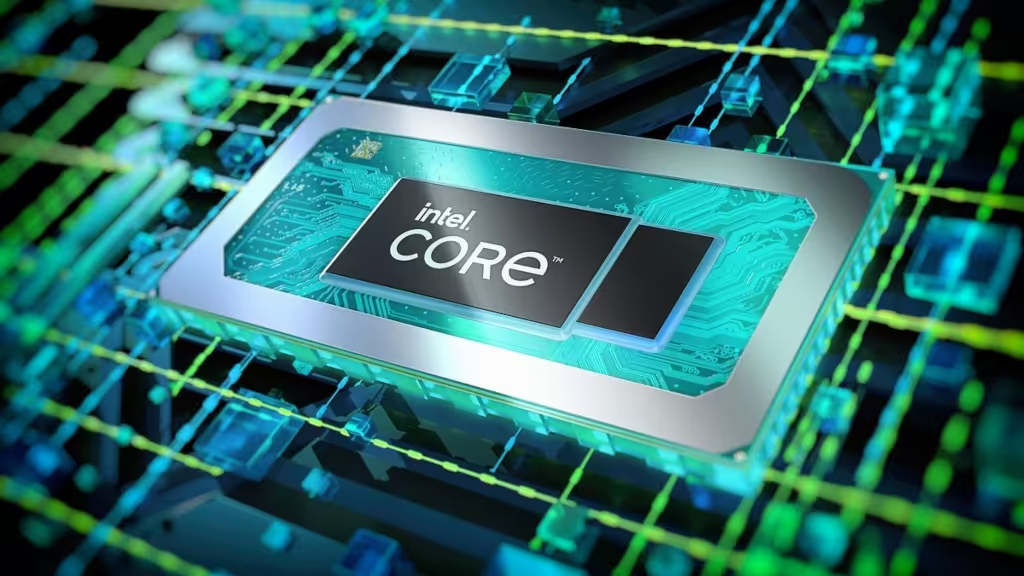
The Intel N-series is retiring the Pentium and Celeron brands to unify them under a simplified "Intel N Processor" identity. Launched in 2023, this line has evolved from Alder Lake-N to Twin Lake, and now prepares for Wildcat Lake, leveraging the 18A process for the first time in entry-level computing. This evolution reflects Intel's commitment to delivering efficient, value-oriented processors for the educational and budget market segments.
The N-series combines modern architecture with energy efficiency, offering a compelling alternative to older designs. As the line prepares to embrace the 18A process node, it marks a significant milestone in Intel's strategy to democratize access to advanced technology, even in low-power devices.
Brand Simplification and Strategy
Intel's decision to consolidate its low-end portfolio under the "Intel Processor" brand was a strategic move aimed at eliminating consumer confusion. The previous naming scheme, which included Pentium Silver, Pentium Gold, and Celeron, created a fragmented identity for entry-level products. By unifying these lines, Intel created a clean, recognizable brand that directly targets value-conscious users and educational institutions.
The N-series family employs a simplified hierarchy: the 4-core models are branded "Intel Processor," while the more powerful 8-core variants adopt the "Intel Core i3-N" designation. This distinction allows Intel to maintain a clear product tier while still leveraging the familiarity and trust associated with the Core brand [citation:1][citation:2].

Architecture and Manufacturing Process
All processors in the initial N-series generation were manufactured on the Intel 7 process and exclusively utilize Gracemont efficiency cores, based on the Alder Lake-N design. This architecture prioritizes efficiency over raw performance, resulting in an exceptionally low TDP ranging from 6W in 4-core models to 15W in 8-core models [citation:2][citation:12].
| Feature | Specification |
|---|---|
| Architecture | Alder Lake-N (Gracemont E-cores) |
| Process Node | Intel 7 |
| Threading | None (No Hyper-Threading) |
| Core Counts | 4 cores (N100, N200) or 8 cores (N300, N305) |
| TDP Range | 6W - 15W |
Evolution: From Alder Lake-N to Twin Lake
The first major update to the N-series came with the Twin Lake generation, introducing the N150, N250, N350, and N355 models. These processors are a "clock speed update" of their predecessors, maintaining the same Alder Lake-N architecture but with increased frequencies [citation:9][citation:12].
| Processor | Cores | TDP | Performance |
|---|---|---|---|
| N100 | 4 | 6W | Baseline |
| N150 | 4 | 6W | +10% single-core, +30% multi-core |
| N350 | 8 | 7W-15W | Higher-end performance |
The N150, for instance, delivers a 10% increase in single-core performance and nearly 30% in multi-core compared to the N100, making it a tangible improvement for multitasking and complex web applications [citation:9][citation:14].
The Future: Wildcat Lake and the Leap to 18A
The most significant evolution of the N-series is the arrival of the Core Series 3 family, codenamed Wildcat Lake. This launch breaks the tradition of using older process nodes for entry-level processors. For the first time, Intel is bringing its most advanced 18A process to low-cost chips, sharing silicon with its high-end Panther Lake processors [citation:5][citation:10].
Wildcat Lake chips will utilize "Cougar Cove" P-cores and "Darkmont" E-cores, along with an NPU 5 and Xe3 GPU. However, the integrated NPU will only offer 17 TOPS, which does not meet Microsoft's "Copilot+ PC" standard of 40 TOPS. Consequently, these processors will lack advanced AI features like "Recall" [citation:5].
Market Context: This strategic move is a direct response to pressure from Qualcomm and its Snapdragon X, which does meet AI standards, and to the threat of Google's "AluminiumOS" project [citation:5][citation:10].
Official Links and Specifications
For detailed technical specifications, please refer to the following official Intel resources:
- Intel Processor N100: Intel ARK Product Page
- Intel Processor N200: Intel ARK Product Page
- Intel Core i3-N305: Intel ARK Product Page
- Intel Processor N150 (Twin Lake): Intel ARK Product Page
- Intel Core i3-N300: Intel ARK Product Page
Intel Official N-Series Page: Intel Processor Family
Market Positioning, Pricing, and Availability
The N-series has become the de facto standard for budget laptops and mini PCs worldwide. Devices ranging from educational Chromebooks to industrial NAS systems leverage the N-series' efficiency and affordability.
- Mini PCs: The Intel N100 and N150 are widely used in products like the Beelink EQ14 and FutureNUC Flexbox.
- Chromebooks: Educational models like the ASUS Chromebook CM12 and Lenovo 14e Chromebook Gen 3 are powered by the N-series.
- Industrial Systems: Companies like SECO and AAEON integrate N-series chips into their COM Express and SMARC modules for edge computing.
Conclusion on Positioning
The Intel N-series represents a masterclass in efficiency and value. From the initial Alder Lake-N models to the upcoming Wildcat Lake generation, Intel has consistently delivered processors that prioritize energy efficiency and affordability without sacrificing modern features. While the lack of advanced AI capabilities in the upcoming Wildcat Lake chips may limit their appeal for some, their adoption of the 18A process marks a significant milestone for budget computing. For users seeking quiet, cool, and dependable performance in a compact form factor, the N-series remains an outstanding choice.
 JuLy Patrick
Senior Technical Writer & Hardware Specialist
eBits Tech Platform | Editorial & Hardware Research Department
@ ebits.icu